
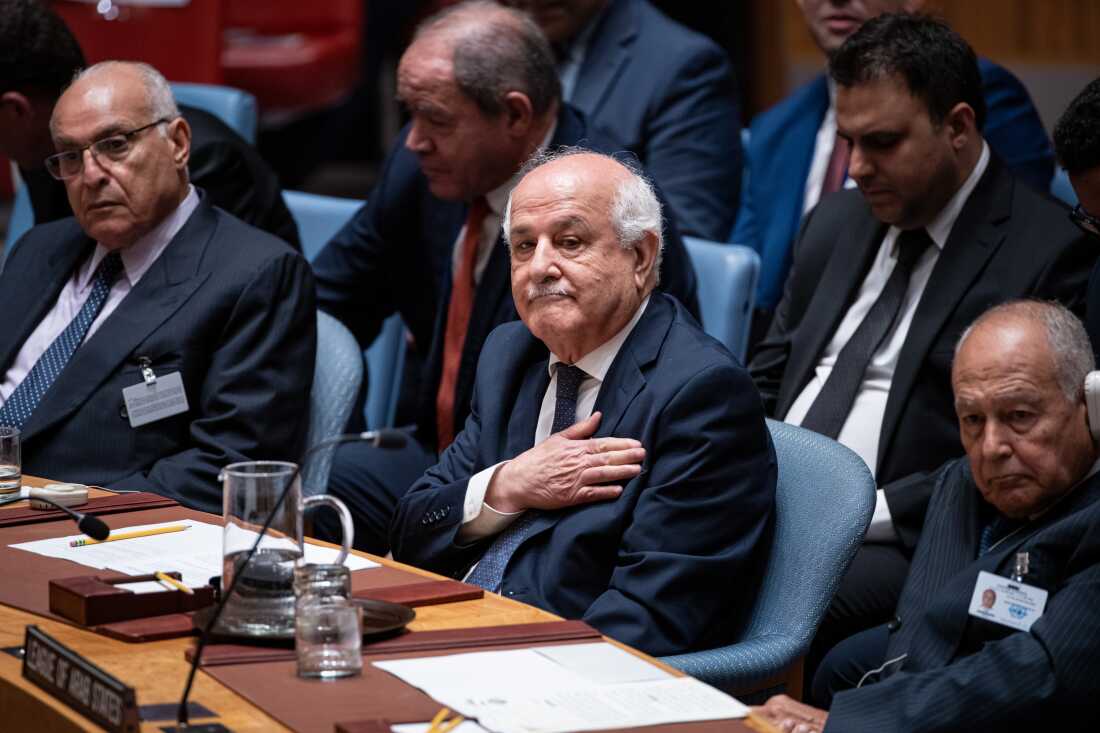
The Palestinian Ambassador to the United Nations, Riyad Mansour, expressed his connection to his audience by patting his heart during a high-stakes meeting at the United Nations General Assembly. This moment took place in response to an address by the Kuwait crown prince during a meeting focused on Palestinians and Israel.
Meanwhile, the U.S. government has issued a strong directive concerning Mansour’s aspiration for a role as vice president of the General Assembly. A U.S. State Department cable, dated May 19, 2025, obtained by NPR, details the consequences the Palestinian delegation may face, including visa revocation, unless Mansour withdraws his candidacy.
The cable mentions Mansour’s past accusations of Israel committing genocide and argues that his candidacy increases tensions and negatively impacts President Trump’s peace plan for Gaza.
There is pressure from U.S. diplomats in Jerusalem to convince Palestinian officials to drop Mansour’s bid for one of the 21 vice president positions at the U.N. The cable warns that the U.S. Congress would take the matter seriously if Mansour continues his run.
The Palestinian Authority President Mahmoud Abbas’ office has chosen not to comment on the situation. The cable emphasizes that revoking the visas of the Palestinian delegation would be regrettable. Ahead of the previous year’s U.N. General Assembly, the Trump administration had already denied U.S. visas to key Palestinian figures, including President Abbas, though they did not extend this to the entire delegation.
In September 2025, the U.S. Department allowed visa sanctions waiver for Palestinian officials assigned to the PLO’s UN Observer Mission in New York. However, revisions of this decision may be on the horizon.
Reactions to Possible Visa Revocation
Criticism for the visa threats has come from various quarters, including Hady Amr, a senior State Department official on Palestinian affairs during the Obama and Biden administrations. Amr expressed that using visa restrictions is rare for scenarios beyond severe cases like espionage or election interference. He believes it undermines problem-solving capabilities of both the affected diplomats and the United States as a mediator.
The State Department has stated its obligations under the UN Headquarters Agreement but refrains from commenting on specific cases due to visa record confidentiality. A 1947 agreement restricts the U.S. from barring UN officials from visiting the UN in New York, though exceptions have occurred for security reasons, affecting individuals from Iran, Russia, and former Palestinian leader Yasser Arafat.
Withdrawal and Current Race
In February, Mansour withdrew his bid for the presidency of the UN General Assembly following lobbying from the U.S. The decision was met with approval from Israel’s UN Ambassador, Danny Danon, who criticized the bid as an attempt to turn the UN into a venue for political opposition against Israel.
The vice presidency elections are scheduled for June 2. The Palestinian ambassador is currently among candidates from Asia and the Pacific, alongside Afghanistan, Iraq, and Mongolia.
The U.S. cable outlines concerns that a Palestinian vice president might preside over high-profile UN sessions, portraying this as a ‘worst-case scenario.’
Emotional Speeches by Mansour
Mansour has distinguished himself with heartfelt speeches at the UN. In May 2025, amid conflict in Gaza, he emotionally recounted the tragic deaths of children during Israeli airstrikes, urging for peace and compassion.
He further advocated for ceasefires in August 2025, stressing that stopping the violence could spare lives and alleviate suffering for both Israelis and Palestinians.
This report includes contributions from NPR’s Michele Kelemen in Washington and Aya Batrawy in Dubai.