
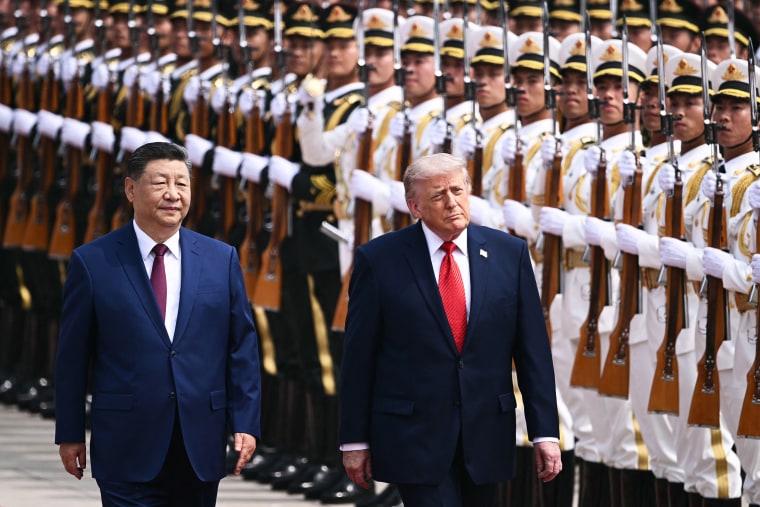
In Beijing, President Donald Trump engaged in critical discussions with Chinese President Xi Jinping. A key focus was on the Iran war and the blockade of the Strait of Hormuz. Secretary of State Marco Rubio articulated that the United States is not seeking Beijing’s assistance with Iran.
Rubio stated, “The Chinese side expressed opposition to militarizing the Strait of Hormuz or implementing a tolling system, aligning with our stance.” Talks between Trump, Xi, and their delegations lasted over two hours.
Despite traveling to Beijing while under Chinese sanctions, Rubio highlighted that Trump and Xi also discussed Taiwan and Jimmy Lai’s situation. Lai, a pro-democracy publisher from Hong Kong, received a 20-year sentence in a notable national security trial. CNN provided comprehensive coverage of Trump’s China trip.
Trump’s agenda included exploring resolution strategies for the U.S.-Israeli war with Iran and the Strait of Hormuz. This blockage has led to global energy supply disruptions and increased gas prices. Trump acknowledged China’s role in bringing Iran to the negotiation table for a ceasefire.
Rubio noted the global impact of oil prices, mentioning, “While we are impacted, other nations are subject to even higher costs.” Despite potential expectations, Trump didn’t request assistance from Xi, affirming, “We don’t require China’s help.” Rubio, sanctioned since 2020 over human rights criticisms, emphasized this stance.
China’s criticism of U.S. and Israeli strikes on Iran, starting February 28, has been evident, urging diplomatic solutions. During discussions, Xi reaffirmed China’s stance against Iran’s nuclear weapon development.
Rubio shared insights post-meeting, noting shared perspectives on Middle Eastern issues.
The Chinese readout didn’t directly reference Iran, mentioning, “Trump and Xi exchanged views on essential international and regional matters, including the Middle East.” Rubio defended Trump’s earlier financial pressure statements, asserting that domestic politics wouldn’t sway him into unfavorable agreements.
Taiwan Tensions
The summit extensively covered Taiwan, a prominent U.S.-China tension point. Xi warned Trump of potential conflicts arising from mishandled tensions. While U.S. has no formal ties with Taiwan, it remains Taiwan’s major international supporter and arms supplier. U.S. law mandates defensive weapon provision to Taiwan; however, “strategic ambiguity” persists about direct military defense if attacked by China.
According to Rubio, “Our policies remain unchanged, consistently upheld across numerous administrations.” Trump’s transactional discussions on Taiwan have incited concerns about possible concessions to Xi. Concerns furthered by conversations implying potential shifts from “not supporting” Taiwan’s independence to “opposing” it.
Rubio downplayed significant discussions on U.S. arms sales to Taiwan during the summit. Recently, the Trump administration disclosed an $11 billion arms package to Taiwan, potentially historic in scale, with more in progress. The administration has consistently criticized China’s escalating military pressure on Taiwan through frequent aircraft and vessel deployments.
Rubio commented, “Forced changes in the current status quo pose detriments for both countries.”
Discussions on Jimmy Lai
Trump broached the topic of Jimmy Lai, 78, whose situation epitomizes China’s suppression of dissent in Hong Kong, a region returning to Chinese rule in 1997 after British colonial governance.
China labels Lai as the orchestrator of pro-democracy protests that unsettled Hong Kong in 2019. Rubio remarked, “The president recurrently addresses Lai’s case among others, aiming for a favorable response.” While Rubio did not specify Lai’s potential relocation to the U.S., he stated, “Open to viable arrangements, ensuring Lai’s freedom.”