
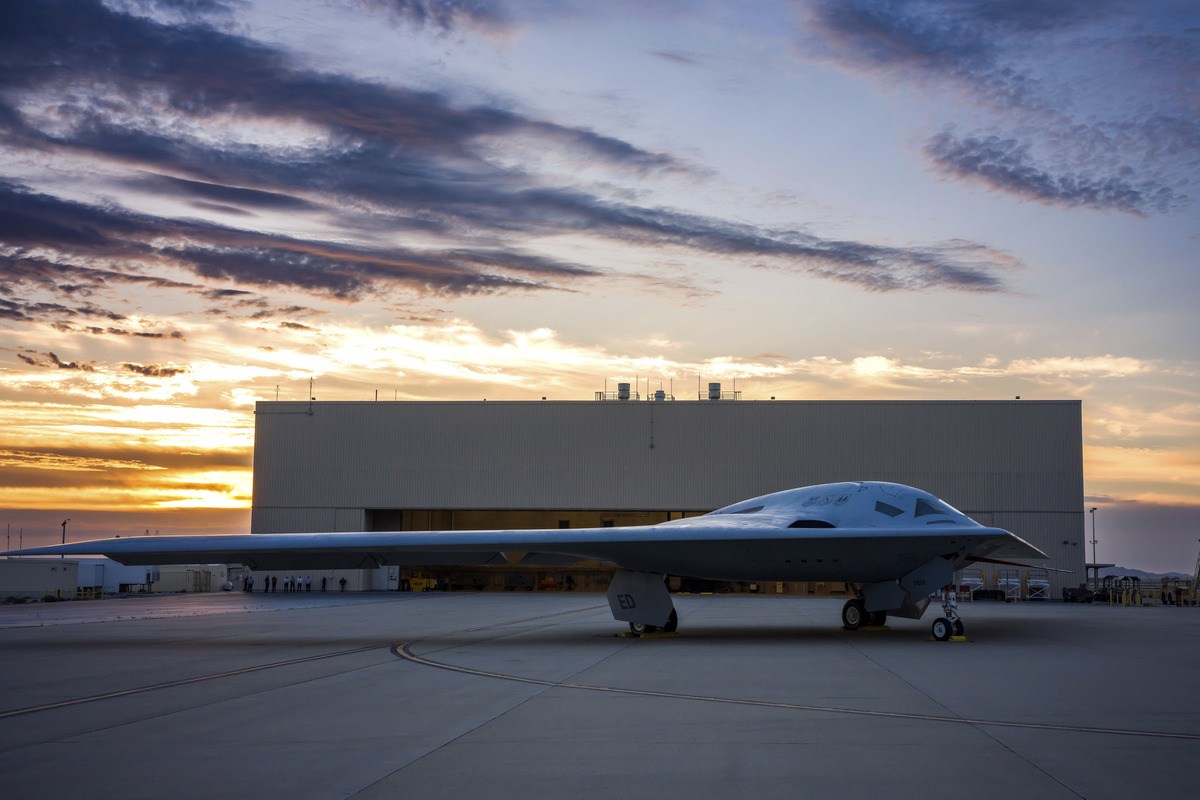
The U.S. Air Force (USAF) has announced a successful weapons test for the B-21 Raider, its next-generation bomber. This achievement comes months before the first stealth bombers are expected to enter service. A B-21 test aircraft conducted the test from Edwards Air Force Base, releasing an undisclosed conventional weapon.
Northrop Grumman, the main contractor for the B-21, hailed the event as a significant milestone for the bomber program. General Ken Wilsbach, Air Force Chief of Staff, praised the program’s progress, emphasizing the B-21’s role in enhancing the U.S. military’s strike capabilities.
The B-21 Raider aims to replace the existing B-1B Lancer and B-2 Spirit bombers. Initial plans reveal the Air Force intends to procure at least 100 units, capable of deploying both conventional and nuclear weapons. The design, first revealed in late 2022, is integral to the U.S.’s nuclear triad, which includes land, sea, and air-based strategic weapons.
The aircraft’s arsenal will include the AGM-181 Long Range Stand Off Weapon (LRSO), a nuclear-capable cruise missile, and B61-12 gravity bombs. Currently, about 200 B-61 bombs are distributed across several European bases. The LRSO is expected to eventually replace the AGM-86B by the late 2030s.
Air Force Secretary Troy Meink highlighted the test as evidence of the U.S.’s rapid adaptability in maintaining strategic deterrence. Tom Jones, a Northrop Grumman executive, echoed these sentiments, noting the bomber’s contributions to unrivaled deterrence capabilities.
The first B-21 bombers will be stationed at Ellsworth Air Force Base in South Dakota, anticipated to become the primary operational hub. Additional deployments are planned for Whiteman Air Force Base, Missouri, and Dyess Air Force Base, Texas.
The B-21 is classified as a sixth-generation bomber, representing the next technological step in military aviation. These advanced aircraft, equipped with drones for high-risk tasks, aim to offer increased protection for pilots. The production cost, initially estimated at $550 million per unit in 2010, has since risen to nearly $700 million due to inflation adjustments.
Beyond the bomber development, the USAF is working on two sixth-generation fighter jets, the F-47 and the F/A-XX for the U.S. Navy. International collaboration is evident with the Global Combat Air Programme (GCAP), including the UK, Italy, and Japan, drawing interest from countries like Saudi Arabia and Germany.
The B-21’s design resembles the B-2 but will be slightly smaller. Named after the Doolittle Raiders, who executed a significant mission in World War II, the bomber reflects historical military prowess and strategic innovation.
Production capacity is set to increase by 25% following a February announcement, with expectations of producing seven to eight B-21s annually, according to specialist media reports.