
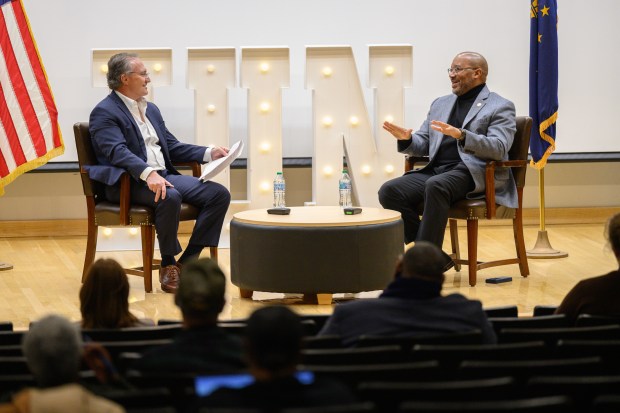
Chancellor Arrick Jackson of Indiana University Northwest reflects on how his military service shaped his career in higher education. “That military discipline, if you will, that the soldier should be able to control a lot of things that are happening around the same time really helped me get through that period in my life,” Jackson explained. His experiences in the military instilled persistence, discipline, and strategic thinking, key elements that now influence his professional endeavors.
During a live interview with Patrick Russell, founder of the Making History Project, Jackson shared insights from his time in the U.S. Army. The interview was part of IUN’s Veterans Week programming, held on Wednesday, November 11, 2026.
“The overall persistence, discipline, strategy, new ideas, new innovative ways of thinking, I think all of that experience contributed to what I do now,” Jackson noted.
Having joined the military in 1987, Jackson served as both an airborne officer in field artillery and a noncommissioned officer in military intelligence, achieving the rank of sergeant. His journey began in Saginaw, Michigan, where he endured a tough childhood marked by the deaths of both biological parents before age nine. Despite these hardships, Jackson graduated high school at 16, carrying the belief that he had to forge his own path.
Jackson originally aspired to a career in criminal justice. He decided to enlist in the U.S. Army, a choice influenced by family connections to military service, although those influences were not prominent due to the aftermath of the Vietnam War. “I just remember saying to myself, at the age of 9 or 10, that if I was going to make it in this world, I would have to do it myself,” Jackson recounted.
Describing how he informed his adoptive mother of his decision, Jackson said, “I told her, ‘Look, I’m joining the army, and I’ll be leaving Friday.’ She didn’t say much, but she took my bed apart and threw it out in the front yard.” Reflecting on the discipline of military life, he said it felt akin to his upbringing.
Jackson’s military experience included airborne training, where he learned to jump from aircraft. Although initially thrilling, he requested to exit the unit due to safety concerns. The response he received was firm: “Quit is not in the vocabulary of an airborne soldier,” Jackson recalled the officer saying.
His second enlistment led him to military intelligence roles, where he served in Germany and Korea. In Korea, volunteering at an orphanage and engaging in academic pursuits motivated his interest in higher education, culminating in his pursuit of a doctorate and career in academia.
During the interview, Russell inquired about the role of education in democracy. Jackson emphasized its importance, advocating for an educated populace as a societal benefit. “My mother always emphasized the importance of having an education,” he added.
Closing the discussion, Russell commended Jackson’s accomplishments, citing his impact and contributions to education. “Mission accomplished, Dr. Jackson,” Russell concluded.