
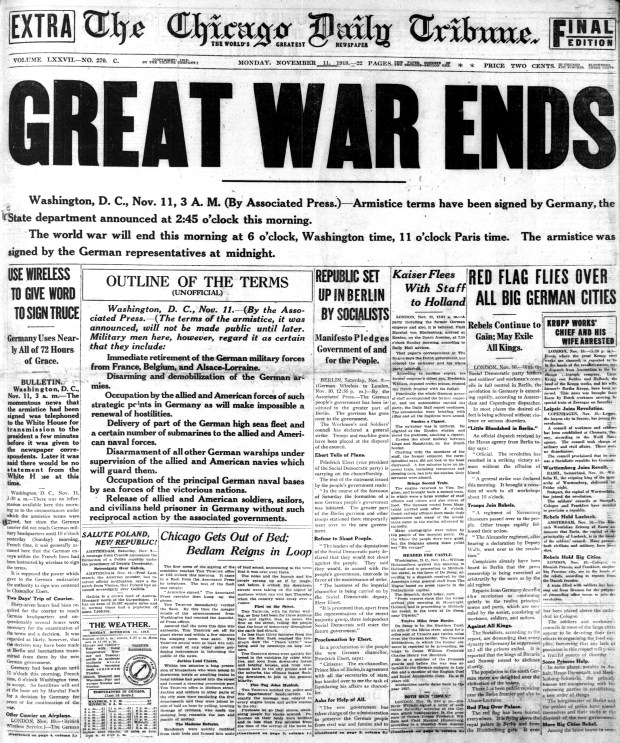
End of World War I Celebrations in 1918
On November 11, 1918, Chicago celebrated the end of World War I with exuberance. Veterans and civilians filled the streets, expressing their joy and relief. According to a report, people tossed their hats in the air, and girls gleefully took caps from men, leading to joyful embraces. The news marked a turning point, with the sentiment expressed that the war was over and the soldiers would come home.
A year later, Chicago began commemorating Armistice Day with a minute of silence at 11 a.m. to honor fallen soldiers. This solemn moment was followed by festive activities, including fireworks and ticker tape in downtown Chicago, creating a blend of Memorial Day, Fourth of July, and Christmas celebrations.
The celebration of the war’s end was a significant cultural moment, symbolizing peace and the return of soldiers.
Weather Records on November 11
Chicago’s weather has shown extreme variations on November 11 throughout the years. Recorded high temperatures reached 74 degrees in 1964, while the low dropped to 13 degrees in 2019. Notable precipitation included 3.18 inches in 1881, and there was a snowfall of 3.4 inches in 2019.
The Great Blue Norther of 1911
An epic cold front, known as “The Great Blue Norther,” swept across the Midwest on November 11, 1911. This led to a dramatic temperature drop in Chicago, from 74 degrees on November 11 to 13 degrees by the evening of November 12. The phenomenon marked the largest two-day temperature change recorded in the city’s history.
Soldier Field Events
On Armistice Day in 1925, Municipal Grant Park Stadium was renamed Soldier Field. Despite this, the Tribune referred to it as Soldiers’ Field in publications. A year later on November 11, 1926, Soldier Field hosted its first professional football game. The Chicago Bears played against the Chicago Cardinals, securing a victory with a score of 10-0. However, Soldier Field did not become the Bears’ home stadium until 1971.
Spider Dan’s Climb in 1981
November 11, 1981, witnessed an astonishing feat by Dan Goodwin, known as “Spider Dan.” In temperatures around 40 degrees, he climbed the 100-story John Hancock Center. Despite attempts by firefighters to stop him, Goodwin persevered, reaching the top after six hours. His climb prompted discussions involving Fire Commissioner William Blair, Mayor Jane Byrne, and Police Superintendent Richard Brzeczek, who eventually decided it was safer to allow him to continue. By 1 p.m., Goodwin triumphantly raised his fist as he completed the climb, greeted by police at the summit.