
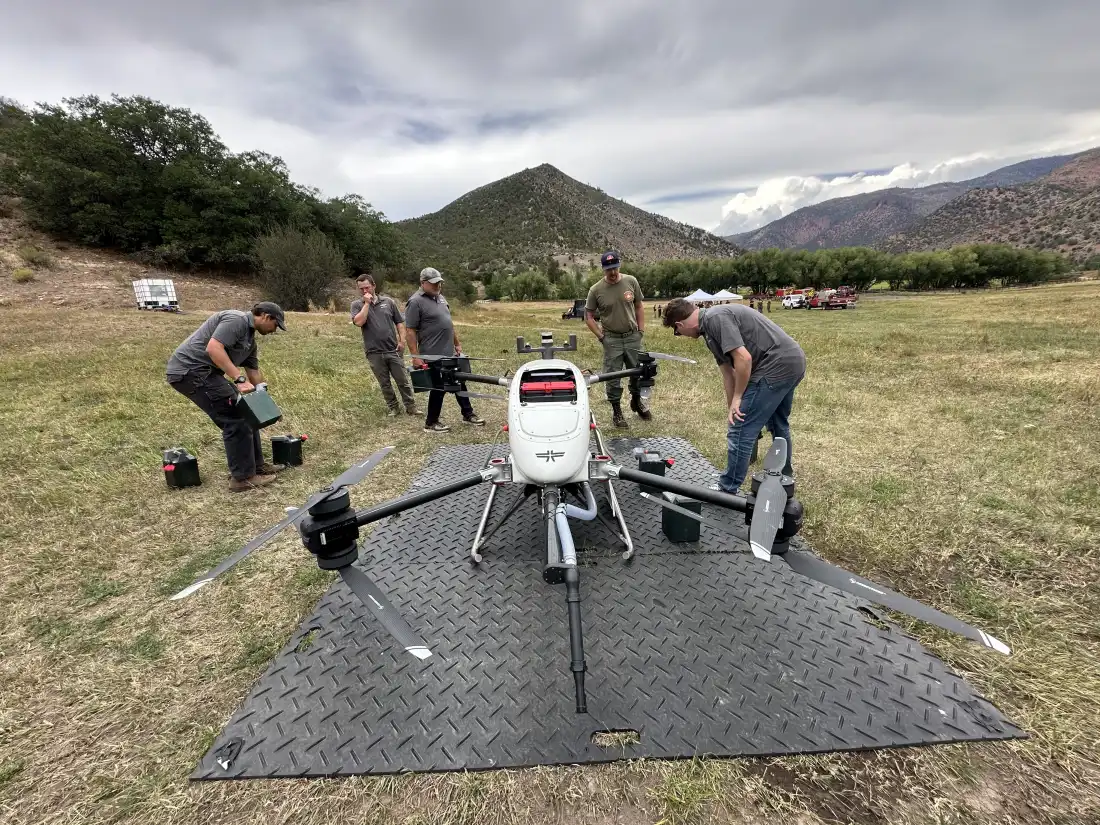
In Aspen, Colorado, fire crews are breaking new ground by learning to operate drones designed by Seneca. These drones are capable of carrying and dispensing fire-suppressing foam. The training is taking place against the backdrop of an overcast day, with red-and-white fire trucks stationed on the grassy terrains of Western Colorado’s mountains.
Members of the Aspen Fire Protection District gather around an iPad, focusing on one volunteer controlling a large drone, resembling an outsized insect. With black and white markings and propellers on four substantial arms, the drone spans about 10 by 12 feet. It resembles the size of a small trailer. Although drones have been used for wildfire monitoring for many years, this new model integrates AI to potentially aid in extinguishing fires.
On August 24, 2026, one Seneca drone was spotted over private land outside Aspen. The local fire department aims to be the first in the United States to independently run these drones after completing the necessary training. This pioneering machine, developed by the California-based company Seneca, works efficiently in swarms. Each drone, capable of carrying between 500 to 1,000 gallons of fire foam, operates similarly to a small fire engine. Aspen firefighters find the drones easy to manage. Deputy Chief Andy Fisher humorously remarked, “We were joking that my 12-year-old could fly these things.” When Aspen Fire finally deploys this new drone program, they will be setting a precedent for independent operation worldwide.
Currently, Seneca’s drones have been utilized under company supervision during controlled burns in California. Fisher emphasizes their potential, particularly in reaching remote fire locations, such as lightning strikes, before human crews arrive. Aspen is surrounded by dense forests, serving as a costly tinderbox with limited evacuation paths. Fisher believes rapid intervention while fires are small could be the optimal strategy.
According to Seneca’s founder, Stuart Landesberg, these drones are versatile, traversing difficult terrains swiftly within a range of 5 to 10 miles, extending further if not loaded. An AI-enhanced “sensor suite” aids in calculating distances and wind conditions, allowing precise water or retardant application. Landesberg likens the technology to a “flying Waymo,” yet acknowledges it isn’t replacing air tankers for large fires. Nevertheless, drones offer advantages as efficient carriers and monitors at significantly reduced costs. Aspen Fire will allocate approximately $2.5 million over five years for this venture, supported by private donors.
Monitoring global interest, Aspen’s experimental drone use could influence other fire departments contemplating similar technology. Veteran firefighter Joe Stutler, not affiliated with Aspen Fire or Seneca, supports technological advancements. He is optimistic about drones potentially facilitating nocturnal firefighting, typically hindered by restricted aircraft operations, and increasing safety for personnel both airborne and on the ground. He eyes technology reducing occupational hazards, acknowledging the sobering reality of firefighting fatalities.
“You look at how many wildland firefighters that have died this year — some aviation accidents,” Stutler said.
However, Stutler approaches with healthy skepticism, noting that while drones show promise during controlled conditions, their effectiveness in actual wildfires remains unproven. Despite a preference for empirical results, he remains open to trying the technology.
The FAA has granted Aspen Fire clearance, allowing drone operation up to 200 feet within Pitkin County once training concludes. Current regulations prevent drone flights over populated zones, necessitating constant visual observation. Firefighters must strategically position team members to monitor and guide drone pilots effectively.
Should the drones demonstrate utility, Aspen Fire aspires to request broader operational permissions to assist statewide firefighting efforts.