
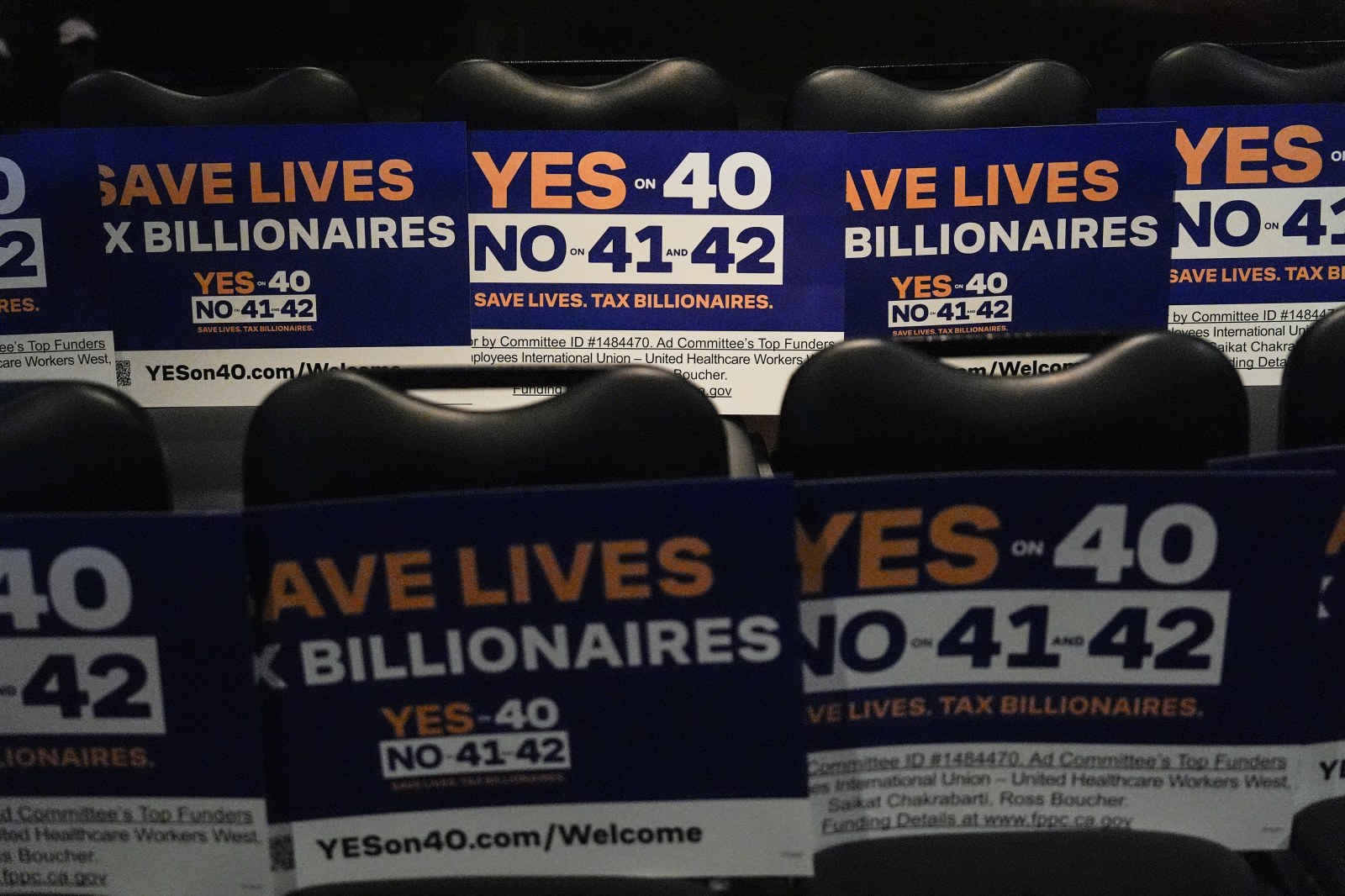
California voters have dismissed Proposition 40, a proposed measure that would have implemented a tax on billionaires’ net worth, making California the first state to undertake such a taxation. The Associated Press called the race six days post-Election Day.
This decision concluded a significant division among top Democrats. Governor Gavin Newsom, eyeing a potential presidential run in 2028, opposed the tax, arguing it could drive wealthy residents out of the state. Meanwhile, Senator Bernie Sanders and Representative Ro Khanna, both prominent progressive figures, supported the tax measure.
According to the Secretary of State’s semi-official tally, as of 5:14 p.m. Monday, 5,789,026 voters (representing 52.9 percent) rejected the proposition, while 5,159,356 voters (47.1 percent) were in support of it.
Financial Backing of Proponents and Opponents
Opponents greatly outspent supporters, with Building a Better California, a committee leading the opposition, raising over $333 million. Sergey Brin, co-founder of Google, contributed more than $100 million against the proposition.
Details of Proposition 40
The measure aimed to impose a one-time tax of 5 percent on billionaires living in California as of January 1, 2026. The tax would have been due in 2027. The Legislative Analyst’s Office detailed that 90 percent of the funds would have supported health care, with the remainder allocated to education, food assistance, and covering the tax’s administrative costs.
SEIU-United Healthcare Workers West, the sponsoring union, estimated a $100 billion revenue, whereas official projections from the Legislative Analyst’s Office estimated “tens of billions of dollars” over several years, alongside a “possible ongoing decrease of less than $1 billion per year” in state income tax from billionaires.
Debate Among Economists
Economists had differing views on the financial impact. A Hoover Institution paper predicted the tax would generate around $30 billion, less than a third of the union’s forecast, citing that approximately 30 percent of the tax base had already relocated from the state. It calculated a net negative value of $38.9 billion for the state when accounting for lost income taxes.
Conversely, a paper from the National Bureau of Economic Research, co-authored by one of the tax’s drafters, estimated the tax might raise around $100 billion. The paper noted California’s billionaires currently pay about 0.2 percent of their wealth annually in state income tax, totaling about $3.2 billion or 2.4 percent of the state’s total income tax revenue.
Countermeasures and Anticipated Departures
Building a Better California also supported Propositions 41 and 42, crafted to counter the wealth tax. The Legislative Analyst’s Office warned these could override Proposition 40 in court if they received more “yes” votes.
Proposition 42 emerged as a key player, seeking to constitutionalize a ban on new taxes on financial assets and most retroactive taxes. As per the count at 5:14 p.m. Monday, it led with 51.7 percent in favor versus 48.3 percent against, with 5,612,642 votes supporting and 5,244,738 opposing. The AP had yet to call this measure.
Some targeted by the tax already exited California. Google co-founders Sergey Brin and Larry Page started relocating before the January 1 residency cutoff. Meta CEO Mark Zuckerberg remains committed to staying in California for eight years, as disclosed in October filings, in return for non-voting shares he can sell to cover taxes without losing control.
A Split Among Democrats
Senator Bernie Sanders advocated for the tax, declaring that wealth disparity hinders national prosperity. Representative Ro Khanna described Proposition 40 as a critical ballot initiative. Governor Newsom proposed a federal minimum tax on the ultra-wealthy instead, acknowledging inequality but diverging on this approach.
Pre-election polls suggested a tight race. A UC Berkeley poll indicated 45 percent of registered voters supported the tax, 43 percent opposed, and 12 percent were undecided.
Future Implications
Should Proposition 42 pass, any wealth tax proposal would require another constitutional amendment. Labor leaders view the campaign as an initial move, with California Federation of Labor Unions President Lorena Gonzalez asserting resilience against opposition.
The ballot count is ongoing, with results pending certification.
Newsweek reached out to involved parties for comments regarding the election’s outcome.