
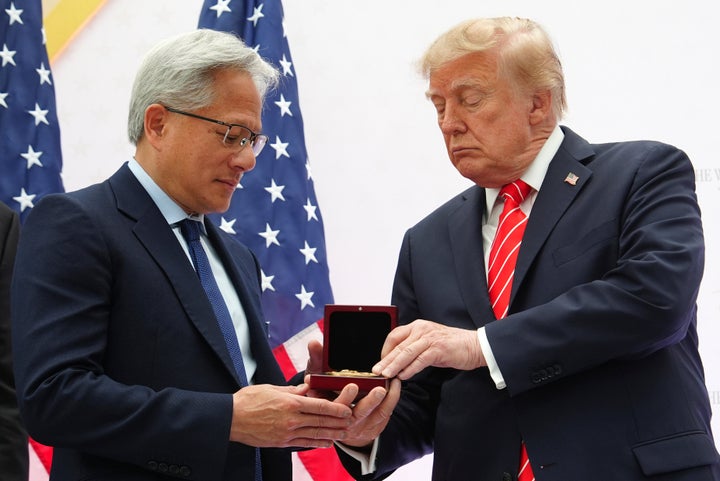
President Donald Trump allowed Jensen Huang, CEO of Nvidia, to engage in discussions with China, despite U.S. intelligence concerns about Huang’s connection to a suspected Chinese spy. Nvidia, a major computer chip manufacturer, was permitted to sell advanced chips to China during this time, as Trump claimed a need to outpace China in artificial intelligence (AI) advancements.
Jensen Huang’s company donated $25 million to Trump’s ballroom project, leading some to question if this influenced Trump’s decisions. Even as Nvidia began investigating Huang after his admission of an affair with an executive from a Malaysian company, Trump showed unwavering support.
Trump dismissed claims of Huang’s wrongdoing, stating, “I think he’s an honorable guy,” when asked about Huang’s involvement with the suspected spy. Trump admitted being aware of the affair with the alleged spy but insisted Huang likely had an explanation for it. Trump remarked, “I believe he’s suffering greatly,” referring to Huang and stands by his innocence.
Reports suggest that a memo detailing Huang’s situation was circulated earlier, yet Trump claimed minimal awareness of its impact. This admission and his subsequent actions contrast with Trump’s repeated assertions to dominate AI advancements over China.
John Bolton, former national security adviser, noted the lack of clear answers concerning the implications of this situation. Robert Kagan, a former State Department official, criticized the administration’s foreign policy motives, insinuating financial gain as the primary driver.
Rahm Emanuel, former mayor of Chicago, publicly questioned who in Trump’s administration remained aware of Huang’s situation and why no action was taken. The absence of responses from the White House and National Security Council to inquiries exacerbates confusion.
While promoting U.S. leadership in AI, Trump continued to allow Nvidia the sale of chips, including the H200, to Chinese firms. Senators Elizabeth Warren and Jim Banks called for a thorough congressional review regarding Huang’s revelation and Nvidia’s export practices, underscoring national security concerns.