
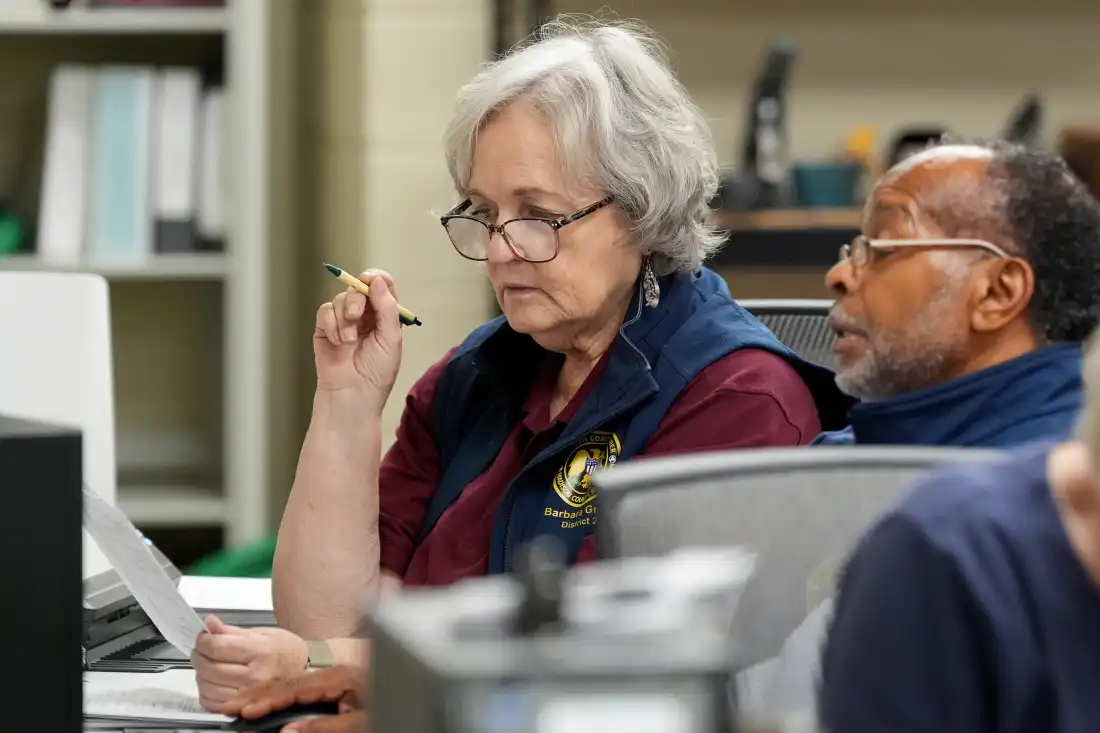
Two election commissioners in Madison County closely examined an affidavit ballot envelope in Canton, Mississippi, amidst the state’s narrow U.S. Senate race. The competition between Republican Sen. Cindy Hyde-Smith and Democrat Scott Colom has highlighted Mississippi’s voting system, known for being slow and decentralized.
Michael Morse, a law professor from the University of Pennsylvania, critiques Mississippi’s election administration. As of Friday, fewer than 2,000 votes separated the candidates. However, determining the number of remaining ballots has proven difficult.
Until we have the certified results, the individual counties will be the best source of the latest and most up-to-date information.
The Colom campaign reported over 15,000 provisional ballots, which require careful verification before counting. On Thursday, the state Republican Party’s chair suggested 20,000 ballots remained, including absentee ballots which are valid if postmarked by Election Day and received by November 10.
Republican Secretary of State Michael Watson noted that counties manage their elections independently. Even his office remains uncertain about the total number of provisional ballots left to count. Around 7,000 of these ballots had been processed by Thursday, with nearly 80% deemed valid.
Mississippi’s 82 counties are not mandated to report election results to the state until next week. This decentralized approach has raised concerns, as Morse expressed his surprise over the lack of accessible data for such a significant race.
The Role of Provisional Ballots
Mississippi shows a relatively high rate of provisional or affidavit ballots, potentially among the highest in the ongoing election cycle. These ballots are made by voters whose eligibility is uncertain. Local officials then decide if these votes count.
If the estimate of 15,000 holds, provisional ballots would account for about 1.5% of the total votes cast in the Senate race. Only four states had higher provisional ballot rates in 2022, according to federal data. Mississippi’s rate could be nearly double that of North Carolina this year.
One reason is Mississippi’s approach to voter registration. In many states, inactive voters can still vote normally for a few years before confirming eligibility. In Mississippi, inactive voters must vote provisionally, prolonging the process as local officials verify their information.
Local media reported on Mississippi’s use of credit data to manage voter lists, with this technique attracting attention. However, Morse believes it’s not the sole issue. Combining credit data with the deviation from typical procedural processes complicates matters.
The extra few minutes it may take to vote via affidavit ballot are well worth the election integrity added by having cleaner voter rolls!
Watson has defended the state’s registration method. Yet, Kathy Boockvar, former Secretary of State of Pennsylvania, argues that many provisional voters will ultimately prove eligible. She notes that the process can appear untrustworthy to those involved.
She emphasized the importance of transparency and data in reducing distrust, especially as Mississippi now gains attention similar to traditional battleground states.