
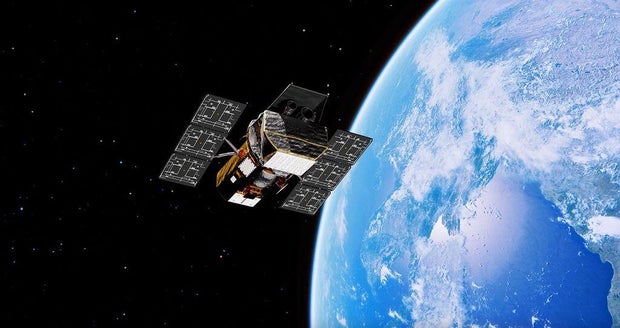
The Swift Observatory, a NASA telescope weighing approximately 1.5 tons, has reentered Earth’s atmosphere. This event occurred over the North Sumatra region of Indonesia at 7:39 a.m. ET, according to NASA. The telescope was launched over twenty years ago to explore massive galactic explosions.
Most of the observatory burned upon reentry, although some components might survive and spread across different regions. NASA, along with the U.S. Space Force, monitored the reentry path. Predictions placed the reentry time around 3:30 a.m. EST on November 4, with an 11-hour margin of uncertainty.
The risk of harm to anyone on Earth was low, with odds estimated at about 1 in 2,100.
The Swift Observatory, deployed on November 20, 2004, was initially on a two-year mission but continued operations until last month. Its mission focused on identifying galactic explosions like gamma-ray bursts and supernovas. Swift’s name derived from its capability to quickly react to these occurrences.
Solar activity eventually forced its return to Earth. NASA contracted Katalyst Space to attempt saving the telescope using a robot, Link. This robot, designed with three arms, faced issues shortly after deployment and couldn’t get within a sufficient distance to the telescope. It also plummeted back to Earth in September.
In August, the decision was made to let the observatory fall back to Earth. NASA halted the observatory’s systems in late October. Swift’s contributions included observing over 2,000 gamma-ray bursts and 1,400 stellar explosions. It also acted as an early warning system for space telescopes like Hubble and Webb, enabling further investigation.
“Swift expanded our knowledge of cosmic phenomena, from galaxies with supermassive black holes to solar system comets,” NASA reported. Finding a successor for Swift’s work poses challenges for scientists.
“We’ve realized this would happen since before the launch. In low-Earth orbit, eventually what ascends must descend. The end is intense,” remarked John Nousek from Pennsylvania State University, leader of the control team.
Nousek emphasized the hope to use Swift’s successes for future space missions to quicken cosmic discoveries.