
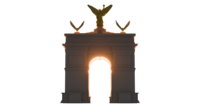
Washington D.C.’s monumental layout is famous for its precise geometric designs and deliberate sight lines. Arlington National Cemetery sits prominently, elevated in the distance as seen from the Lincoln Memorial. President Donald Trump’s proposed 250-foot arch threatens to introduce a significant new element within this space.
To assess the potential impact, The Washington Post constructed a to-scale 3D model. Findings reveal that the arch’s shadow would traverse burial sites within Arlington National Cemetery on 284 days annually. Specifically, Kennedy’s eternal flame would be briefly shadowed on 18 days, and his memorial shaded on 50. The Military Women’s Memorial would experience shading on 109 days. The shadow would stretch over graves of veterans from multiple wars including Vietnam, Korea, both World Wars, Spanish-American, and Civil War.
In total, the shadow would cast over more than 75,000 graves, according to the analysis. While shadows typically fade as the cemetery opens at 8 a.m., on 26 days they would persist, potentially altering the visitor experience.
A White House spokesperson, Davis Ingle, expressed that the arch would further enhance the visitor experience at Arlington, claiming it would become an iconic global landmark. The Interior Department, however, confirmed through its studies that only a minor section would be impacted and primarily during elongated morning shadows.
Their analysis aligns generally with The Post’s findings, though details regarding methodologies were sparse. The arch’s proposed location—about a quarter-mile from the cemetery—has sparked concern among historians and architects for disrupting Washington D.C.’s historically crafted urban landscape.
Neil Flanagan, an architect and historian, emphasized the importance of preserving openness between significant structures. The McMillan Commission of 1902 set distinct projects as jewels within Washington’s borders. A towering arch next to these sites would not fit this vision.
Micki McElya, a history professor, noted the unsettling symbolism of the arch’s shadows upon the cemetery, highlighting it isn’t about seeing shadows but acknowledging their existence. At sunset, shadows from the yet-to-be-built monument reach eastward, touching memorials of assassinated presidents, and monuments dedicated to veterans from Vietnam and Korean wars.
An impactful figure, Paul Eaton, a retired U.S. Army major general, regards the monument’s shadow as sacrilegious—disrespectful to the sacred resting places of valor and prominence. VoteVets raised concerns over this shadow, leading to The Post’s 3D model analysis.
Despite these controversies, Trump’s administration presses on, intent on realizing the arch, even amid legal battles and potential adjustments to height regulations in Washington. Trump’s vision aspires for the arch to eclipse the Arc de Triomphe in Paris, establishing a greater monument.
Federal approval and ground-breaking appear imminent. Impacts on the cemetery during operation would be more pronounced if daylight saving time is implemented year-round. The historical significance of Kennedy’s memorial, particularly the eternal flame, underscores this conflict. His widow, Jacqueline Kennedy, cherished its visibility and significance.
As plans evolve, a flame atop Trump’s arch promises visibility even when shadows obscure Kennedy’s flame, highlighting an intricate layering of historical values and modern ambitions.
The methodology undertaken by The Post involved Trump’s administration plans, USGS lidar data for terrain mapping, QGIS and Blender software for a comprehensive 3D model, and NOAA data for sun positioning. The analyzed shadow paths were based on these models, excluding tree shadow interference.
Editing of the story was by Nadine Ajaka, Maureen Linke, and Eric Rich, with video editing by Peter Stevenson. The graphical content was supported by Luis Velarde from The Washington Post.