
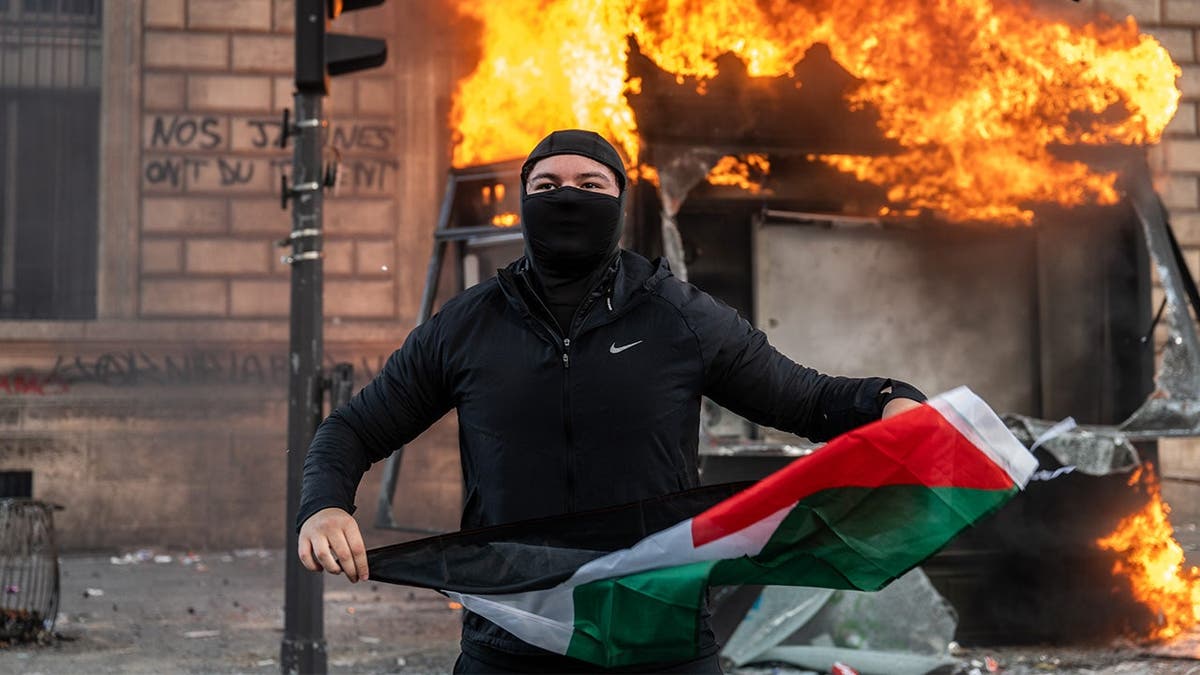
France has expanded its curfews in an effort to manage violent riots that have led to the arrest of 2,400 individuals and damaged 3,000 businesses. National Review’s Noah Rothman commented on the unrest, noting attacks on Jewish sites and businesses, and raised concerns regarding similar potential incidents in the U.S.
Amidst these developments, President Emmanuel Macron proceeded with his planned trip to the Arabian Gulf, intended for energy negotiations, even as his country faced intense riots. His decision to travel has sparked criticism. The riots, which initially began as student-led protests over classroom conditions, have now involved a variety of political and ideological groups across France.
Reports and social media images show men with foreign flags committing acts of destruction in major French cities. Organizations such as communist groups, Islamic advocacy groups, labor unions, and environmental activists reportedly participated in the unrest, as identified in a Fox News Digital investigation.
Despite the national turmoil, Macron went to Kuwait on Sunday and condemned the rioters’ violent actions in a national address. He linked the riots to escalating fuel prices, emphasizing their impact.
French President Emmanuel Macron maintains his commitment to international energy discussions amid domestic turmoil.
French authorities have arrested over 2,500 people tied to the rioting. While acknowledging security lapses, Macron rejected the resignation of his interior minister. Criticism has emerged from both political spectrums. Marine Le Pen accused Macron’s leadership of allowing France to be “caught between violence and impotence.” Meanwhile, Jean-Luc Mélenchon criticized the government for its approach to handling the riots.
The unrest occurs amidst preparations for France’s presidential election. Macron, who is term-limited, sees his centrist allies facing significant challenges against figures like Le Pen and Mélenchon who are leveraging public dissatisfaction. Analysts believe the riots might bolster Le Pen’s chances, given her stance on immigration.
Macron also faced backlash for attending a concert during the riots. Violence has somewhat subsided after the implementation of curfews, yet the riots inflicted substantial damage, with financial estimates exceeding $1 billion. Rioters damaged countless small businesses and historical sites, as noted by Morningstar.
The violent riots in France resonated widely with conservatives in America, who interpreted them as a symptom of declining social cohesion in Europe. Some conservatives caution that similar discord could manifest in the U.S.
Simon Hankinson described the riots as a “warning sign for the United States.” Commentator Ben Shapiro highlighted root causes such as “an out-of-control welfare state” and “left-wing radicalism.” U.S. Vice President JD Vance argued that issues with assimilation and immigration could have contributed to the chaos, expressing these views on social media.
In contrast, American liberal figures like Rep. Ro Khanna acknowledged economic grievances as key factors behind the riots, while still condemning the concurrent violence and vandalism.