
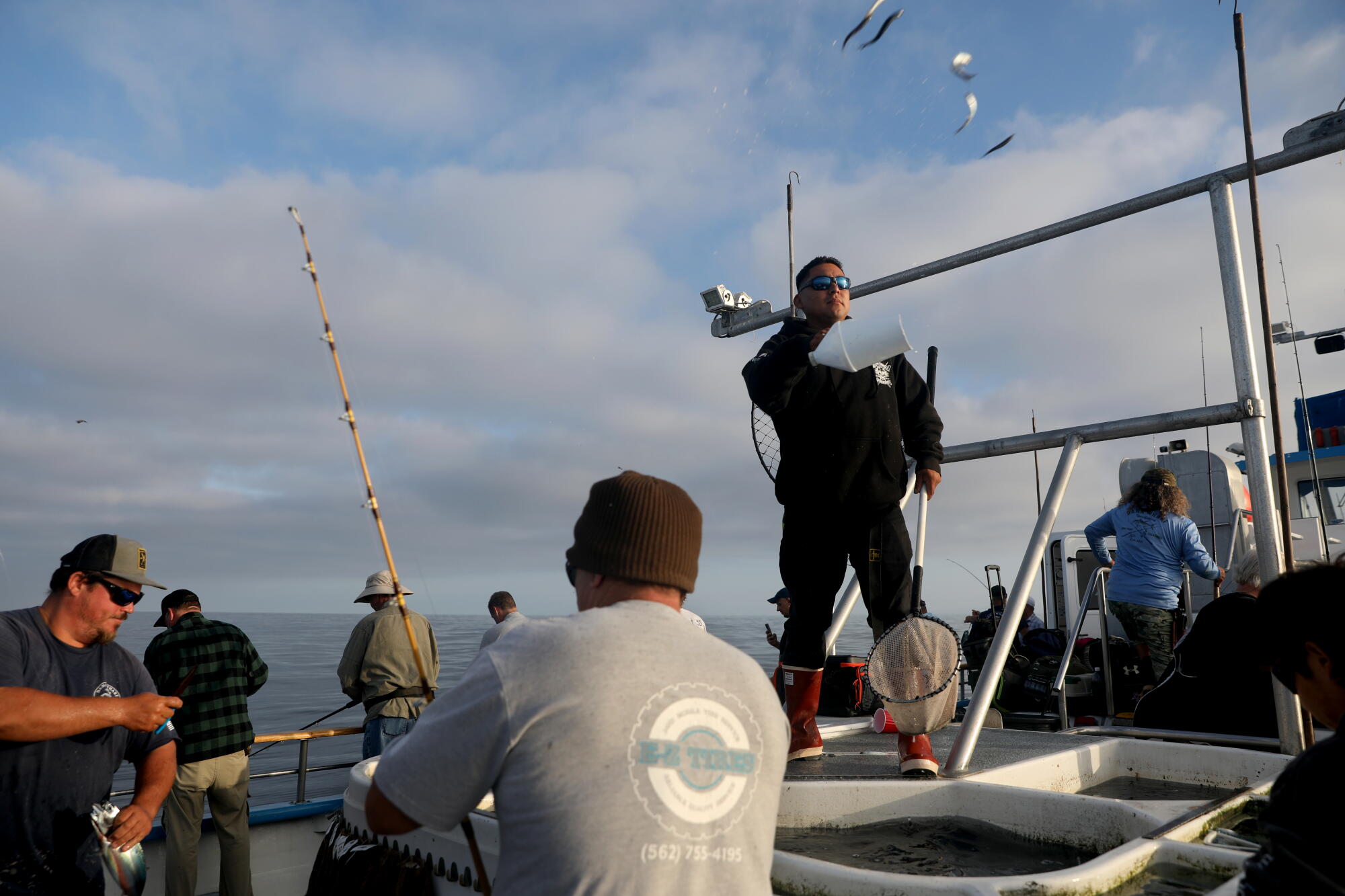
Captain Brandon Erdo skillfully navigated the 95-foot Dana Pride across the waters off the Orange County coast. On this Wednesday morning, the boat was nearly full, with 37 out of 40 angler spots occupied. The buzz about exceptional fishing opportunities due to the super El Niño had reached many through social media.
Erdo called out, “Get a little bait going here, Eric,” over the loudspeaker. A deckhand quickly gathered anchovies and tossed them into the water. Soon, veteran angler Chuck Freeman announced his success by reeling in a 2-foot-long bullet tuna, marking his first catch of this species in 47 years of Pacific fishing. Minutes later, Freeman added another tuna to the haul, their tails creating splashes of red across the deck.
Scientists explain that the ongoing super El Niño has led to a warm water anomaly off the coast of California. This condition has attracted fish typically found in the Indian and Atlantic oceans, as well as around Hawaii and the central Pacific. Recently, visitors to beaches from Orange County to Malibu have reported sightings of rare marine creatures like whale and hammerhead sharks and other unusual species.
“We’re seeing fish that would usually be in Cabo San Lucas right now,” stated Owyn Snodgrass, a biologist from the National Oceanic and Atmospheric Administration. “The entire ecosystem has shifted.”
For recreational fishing companies, this super El Niño has provided a boost. Many tuna and other prized catches are now being caught in U.S. waters, with some species appearing in high numbers for the first time in two years. Notably, this year’s marlin fishing has been historic, with more fish caught than any year since 1990. “This is the future’s ‘Good old days,'” said Mike Conroy, president of the Sportfishing Association of California.
However, the situation at sea is complex. Despite the presence of fish not seen since the last major El Niño a decade ago, fewer are being caught compared to that time. Eric Munoz, a deckhand, noted the unexpected decline. The initial excitement on the Dana Pride faded quickly. Some anglers mentioned that bullet tuna, although present, isn’t a popular catch as they don’t preserve well.
Erdo ordered the anglers to reel in their lines and relocate. A calm hush settled over the boat as the search for fish continued.
Using binoculars, Captain Erdo scanned the ocean surface for signs indicating fish, like disturbed water or birds diving. Sonar equipment provided data on marine life up to 500 feet around the boat. Earlier, Erdo had shadowed a pod of dolphins, which appeared to perform for the onlookers.
Recreational fishing data show that last year, Dana Wharf Sportfishing and Whale Watching, which includes the Dana Pride, only caught two yellowfin tuna. This year, they have already netted over 5,800 yellowfin tuna and more than 150 mahi-mahi, favored by warmer waters. In past warmer years, the catch numbers were significantly higher due to “the blob,” a marine heat wave that disrupted ecosystems.
This year, catches have not reached anticipated levels despite warm conditions. By late September, anglers had caught far fewer yellowfin and skipjack tuna compared to similar conditions in 2015.
NOAA oceanographer Andrew Leising pointed to differences in marine heat wave patterns as a potential reason for these variations. A diminished fishing effort due to economic factors may also have played a role, along with reduced fish availability.
There is a noticeable gap between social media reports and actual fishing outcomes, as noted by Elizabeth Hellmers, a senior scientist with the California Department of Fish and Wildlife. “Exaggeration is just part of being a fisherman,” she stated.
By early afternoon, Captain Erdo led the Dana Pride to a promising spot near floating kelp. Anglers began catching yellowfin tuna, visible swimming near the boat. Erdo advised dropping lures to optimal depths to attract the fish. However, the bite slowed as the fish had likely fed on tuna crabs drawn by the warm waters.
The day’s catch aboard the Dana Pride included 120 bullet tuna, 17 yellowfin tuna, 3 skipjack tuna, and 1 mahi-mahi. Freeman and his son each caught a yellowfin, while others had mixed success with bullet tuna.
“Not an epic day by any means,” Erdo commented over the loudspeaker as customers prepared to disembark. “Keep an eye on the fish counts. I don’t think this fish is going anywhere.”