
Letonia Copeland-Hardin values the trust of her audience. As a postdoctoral researcher at the University of Chicago, she builds this trust in her study of pollutant exposure and cancer risks while working with community members. Additionally, as a stand-up comedian, she engages the audience every time she steps on stage. Now, she merges these two fields by employing stage techniques to connect better with the communities researchers study.
Alongside her colleagues, researcher Myeshia Shelby and comedian Kelsie Huff, Copeland-Hardin developed “Reading and Working the Room.” This free-to-use workshop and curriculum helps scientists use on-stage skills to engage effectively with communities involved in research. Her interest in comedy started in childhood when she dreamt of being a stand-up comedian, a dream realized in 2019 after years in research. “I started comedy to cope with stress and isolation during graduate school,” she shares.
While her fields might appear unrelated, “Reading and Working the Room” reveals their intersection. Copeland-Hardin focuses on community-engaged research, which collaborates with communities rather than studying them in isolation. “You work with community instead of on communities,” she emphasizes. Working with Chicago’s historically harmed communities necessitates a process of trust-building, which Copeland-Hardin sees as vital.
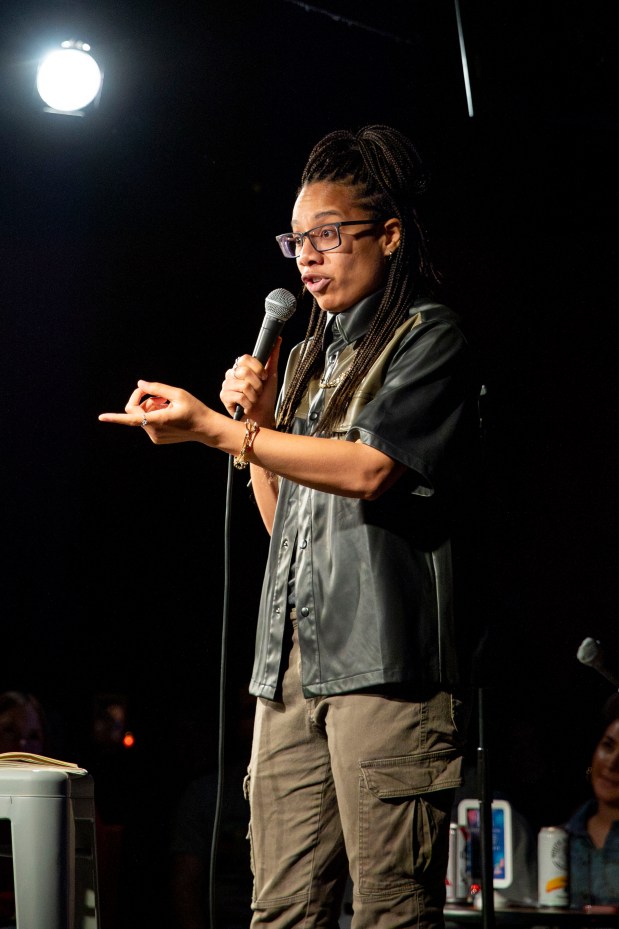
On stage under the name LT, Copeland-Hardin captivates audiences, as seen during her performance at The Lincoln Lodge’s Future of Comedy Festival. By incorporating interactive questions, she transforms her monologues into engaging conversations. Her ability to explain scientific concepts, while telling stories like dissecting a fruit fly brain, captivates her audience, leading to laughter and understanding.
The curriculum aims to teach researchers how to engage with public audiences effectively, filling a gap in traditional scientific training. By using stage techniques, researchers can rebuild trust and gather more accurate data. “Reading and Working the Room” is accessible for anyone interested, with materials available on zenodo.org, thanks to initial funding from Research!America. This support was directed towards addressing public engagement in scientific training.
“As scientists, it is our responsibility to share our information with the public,” Copeland-Hardin believes. At her core, she desires to connect, whether it be with an audience, a community, or within her scientific work. Through these connections, Copeland-Hardin consistently finds a way to engage fruitfully.