
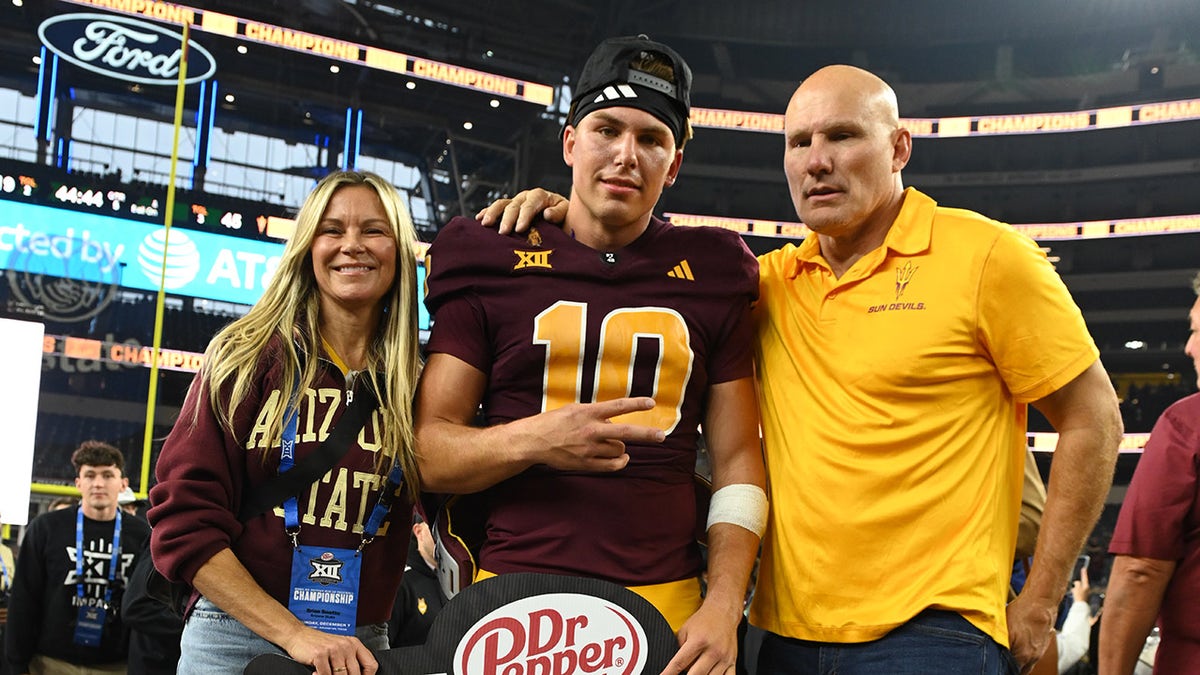
In January 2025, the Arizona State Sun Devils had a surprising success, making it to the College Football Playoff. This achievement came just two years after the end of the challenging Herm Edwards era. Head coach Kenny Dillingham, despite NCAA sanctions and previous seasons of struggle, led the team to a Big 12 championship. His efforts, supported by players like Cam Skattebo, Jordyn Tyson, and Sam Leavitt, brought the team close to securing a Playoff victory over Texas.
Head coach Sam Leavitt celebrated the team’s Big XII conference championship win against the Iowa State Cyclones at AT&T Stadium in Arlington, Texas, in December 2024.
Fast forward two years, and the Sun Devils find themselves at 2-2 with a struggling offense after a harsh defeat by Baylor. Not long after Arizona State’s impressive CFP appearance, coaches Jedd Fisch at Washington and Brent Key at Georgia Tech gained attention on opposite ends of the country.
Jedd Fisch managed to rejuvenate the Washington program he inherited in 2024. Though the team had competed for a national championship before his arrival, Fisch had to replace almost all of the team’s prior production. A promising 6-7 campaign was followed by a nine-win season, capped off with a victory over Boise State in a bowl game, highlighting quarterback Demond Williams as a standout player.
Meanwhile, Brent Key revitalized Georgia Tech in the ACC with an innovative offense and quarterback Haynes King as a Heisman hopeful. The Yellow Jackets reached as high as number seven in the AP Poll, their highest ranking in nearly twenty years, and finished the season ranked for the first time since 2014.
Despite their previous successes, Washington, Georgia Tech, and Arizona State now appear as shadow versions of last season’s teams. Each school faces sharp fluctuations in performance year-to-year, unlike programs such as Ohio State, Texas, Oregon, and Georgia, which maintain consistent excellence due to infrastructure, funding, and talent pipelines.
During the high-demand coaching periods, Dillingham, Fisch, and Key were considered for numerous major jobs in college football. Dillingham was mentioned as a potential replacement at Florida State and Michigan, while Fisch and Key were considered for the Florida opening, with Fisch having connections as an alumnus.
Choosing to stay put, there’s speculation whether these coaches missed opportunities for bigger jobs at more established programs. If their teams finish the season with multiple losses, interest in them as candidates may wane.
Time will tell if these coaches remain satisfied with their current positions, given past comments about funding or aspirations to take other jobs under certain conditions. The future for mid-tier Power 4 program coaches remains uncertain, with the potential to secure prominent positions or fall prey to the volatile nature of college football coaching.
Matt Campbell’s experience at Iowa State is a reminder that patience and loyalty might not always result in missed opportunities. Post his historic seasons, Penn State offered him a new role. In coaching, your latest season defines your worth, as athletic directors often exhibit recency bias when hiring.
A year from now, Kenny Dillingham, Brent Key, and Jedd Fisch may find themselves in prestigious roles or victims of the ever-changing climate of Power 4 college football.