
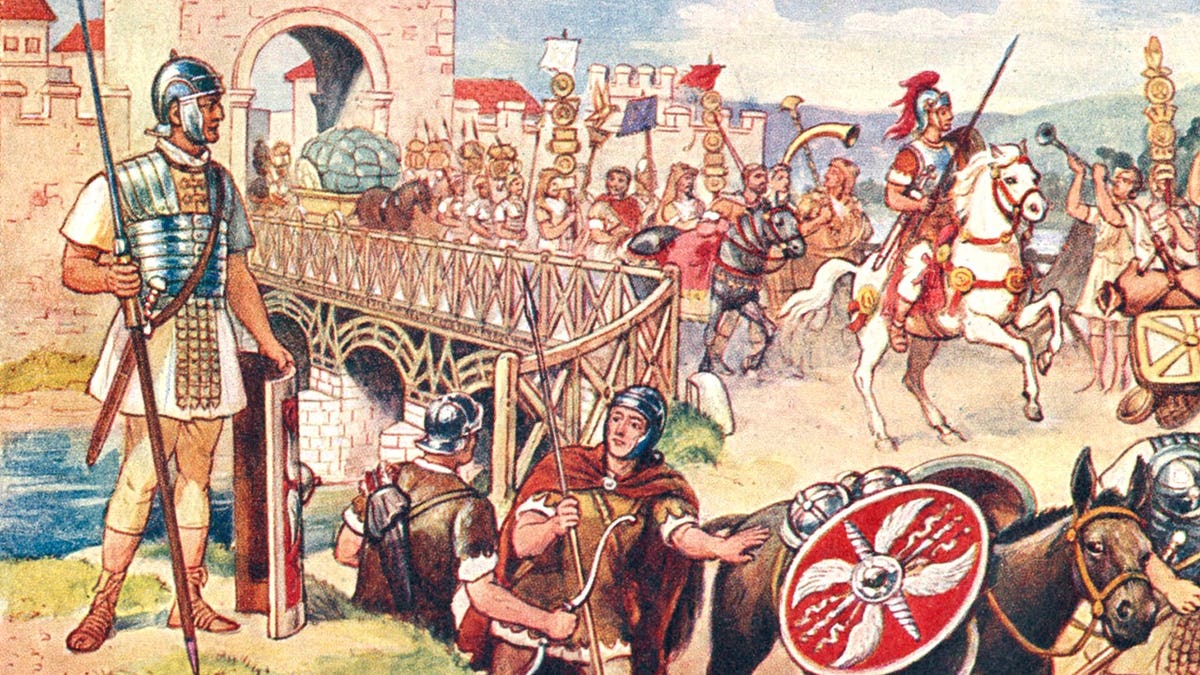
A recent study has questioned the saying, “All roads lead to Rome,” by analyzing the Roman Empire’s extensive road network. Published in the journal Nature Communications on September 15, the research examined approximately 190,000 miles of roads across various regions, including Europe, the Middle East, and North Africa.
Re-evaluating Rome’s Central Role
The study, led by Tom Brughmans, a classical archaeologist at Aarhus University, along with fellow researchers, re-mapped and analyzed the Roman roads. Contrary to popular belief, the study revealed that provincial capitals held significant importance in overland travel, not just Rome.
After Emperor Constantine established Constantinople, now Istanbul, as the imperial capital in the fourth century A.D., it became more central for travel. Its strategic location between Europe and Asia contributed to its significance as a travel hub.
Debunking the Medieval Proverb
The phrase “all roads lead to Rome” emerged long after the Roman Empire’s fall and might not accurately reflect historical realities. Brughmans highlighted that the roads in Roman Britain did not lead to Rome, emphasizing the proverb’s medieval origins.
While Rome remained a political and ideological center, Constantinople attracted significant overland connectivity due to its status as a capital. Taco Terpstra, a professor at Northwestern University, noted that before its rise, Constantinople, known as Byzantium, was a mere fishing town.
Roman Roads and Their Legacy
The research also investigated the straightness of Roman roads, a hallmark of ancient engineering. Despite some deviations due to terrain, Roman roads were constructed as directly as technology allowed during that era.
Originally, Roman roads served military purposes by facilitating troop movement in conquered territories. Over time, these roads became vital for economic activities as well. Despite their durability, maritime transportation was more cost-effective in transporting goods across the empire.
Through this study, new insights are provided into ancient transportation networks, emphasizing that Rome’s role, though central, was not singularly dominant in the Roman Empire’s road network.