
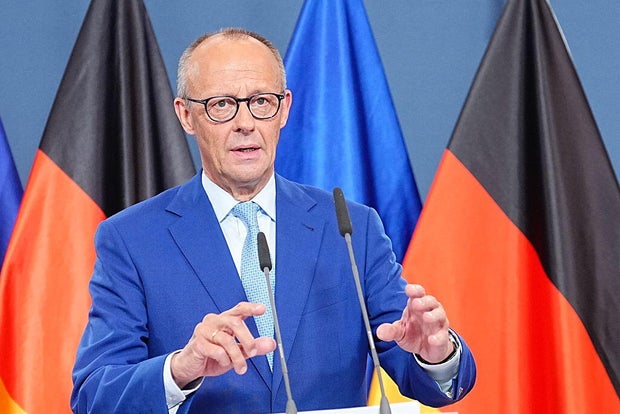
German Chancellor Friedrich Merz has responded defiantly to a significant electoral setback in two state elections, vowing to pursue reforms crucial to Europe’s largest economy. Merz’s Christian Democratic Union (CDU), a center-right party, experienced a dramatic decline, securing only 5% in Mecklenburg-Western Pomerania, the worst result for the CDU in a single state since World War II. Conversely, the far-right, anti-immigration Alternative for Germany (AfD) party has gained traction.
Merz candidly described the election outcome as a “disaster” but emphasized the need for his government’s agenda. He stated that Germany’s economic and political challenges necessitate difficult and potentially unpopular reforms without delay. Addressing the public on TV, Merz asserted, “What needs to be done now requires backbone, steadfastness, and patience,” and pledged to embody these qualities as CDU chairman and chancellor.
Chancellor Friedrich Merz speaks at the Konrad Adenauer House following the elections in Berlin and Mecklenburg-Western Pomerania, Germany on Sept. 20, 2026. Michael Kappeler/picture alliance via Getty Images
In Berlin, exit polls projected the CDU to rank second with 20%, behind Die Linke (The Left Party) at 24.5%. Celebrating her party’s victory, Die Linke’s lead candidate Elif Eralp, of Turkish descent, remarked, “In our city, love and justice have triumphed over hatred.”
The election setback follows disappointment in Saxony-Anhalt, where AfD defeated the CDU on September 6. The result was unexpected for many Germans who believed their nation had overcome nationalism by confronting its Nazi history through education and anti-persecution laws. AfD made substantial gains again, acquiring 37% in Mecklenburg-Western Pomerania and 15.7% in Berlin. However, it has not reached a position to establish a regional government.
Die Linke (The Left Party) lead candidate for Berlin Governing Mayor Elif Eralp celebrates with party supporters at the party headquarters, Karl-Liebknecht-Haus, in Berlin, Germany, on Sept. 20, 2026. Halil Sagirkaya/Anadolu via Getty Images
Tino Chrupalla, AfD’s national co-leader, criticized Merz on ZDF television, stating his persistence is insufficient and urging resignation. Yet, Merz underlined that his administration’s reforms serve as “the antidote to the poison of authoritarianism,” counteracting the growing allure of authoritarian governance.
The CDU has historically governed Germany for most of its post-war period. Merz, 70, assumed leadership 16 months ago, promising revitalization of the economy with stagnant growth issues. Nevertheless, the government faces economic turmoil, failing to satisfy voter expectations for speedy finance and tax reforms. Despite moderate growth returning, the labor market struggles, with unemployment exceeding 3 million in August, marking an increase of 36,000 from the previous year.
AfD’s strong Saxony-Anhalt election performance has further challenged Merz’s leadership. The prospect of forming the nation’s first far-right regional government since World War II has escalated national concerns.
Amidst the mounting criticism, even within the CDU, calls for Merz’s replacement have arisen. Yet, no prominent allies have publicly requested his departure, emphasizing the importance of avoiding leadership debates. Preparing for a challenging post-election period, Merz cancelled his planned visit to New York for the U.N. General Assembly. Despite unfavorable conditions, Merz remains committed to fulfilling his term.
In: AfD Friedrich Merz Germany