
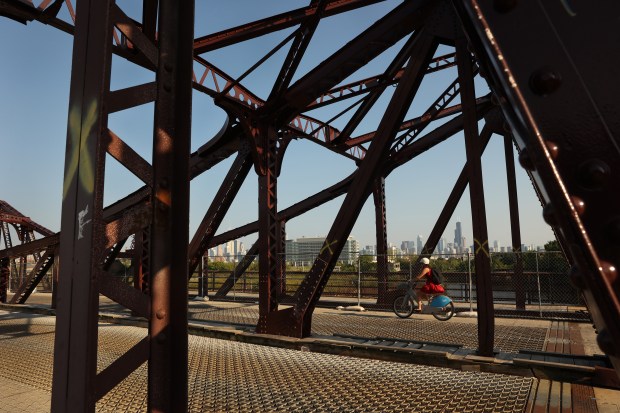
The Cortland Street Bridge has remained closed to vehicles for the past year, leading to extended driving times across the river and causing significant traffic congestion. Residents of the North Side describe the situation as highly inconvenient and frustrating.
This 124-year-old bridge is a landmark in Chicago, being the oldest model of a trunnion bascule bridge. The Chicago Department of Transportation (CDOT) initially closed the bridge to begin a rehabilitation project that was expected to last 18 to 24 months. However, an assessment revealed the bridge to be in worse condition than anticipated, ruling out a simple repair. The project might now extend over several years.
A cyclist rides on the bridge, which is closed to vehicles for prolonged restoration.
The bridge’s indefinite closure has sparked a conflict involving two aldermen who wish to revoke its landmark status to hasten the bridge’s replacement. They believe removing its protected status could speed up building a new, operational bridge.
CDOT, however, warns that removing landmark status will not circumvent state or federal historical review processes. The issue highlights the challenge urban planners face when historical preservation intersects with modern infrastructural needs.
When announcing the bridge closure, CDOT projected reopening in 2027. However, the detailed assessment showed the bridge lacked the structural integrity to support vehicle traffic, necessitating extensive work. Alderman Brian Hopkins criticized CDOT’s handling, calling it a failure to fulfill their responsibility to ensure efficient transport. He plans to introduce legislation to deregister the bridge as a landmark.
The aldermen’s frustration is fueled by public complaints and the added burden of two other concurrent bridge closures at Lake Street and Chicago Avenue. This prompted aldermen to mandate notifications for any bridge closures lasting over a month.
If engineers deem the bridge incapable of supporting vehicles, demolition might be unavoidable,said Ald. Scott Waguespack. He noted the extensive resident dissatisfaction and the limited alternatives remaining for the bridge.
Preservation advocates argue that the bridge is more than an infrastructure piece. Frank Butterfield from Landmarks Illinois claims Chicago’s bridges play a crucial role in the city’s identity. Butterfield highlights the significant role these bridges have played in establishing Chicago as a vital commercial hub. The trunnion bascule bridge design, he explains, was an innovative engineering achievement that attracted global attention.
Ward Miller of Preservation Chicago warns against rescinding landmark status, fearing it might set a precedent jeopardizing other historic structures in the city. He cautions that such a move could undermine the Landmarks Ordinance.
The city’s Department of Planning and Development states that any proposed work on landmarks requires review. There’s an exception for imminently dangerous structures, but CDOT believes there are regulatory barriers to swift action, regardless of the bridge’s status.
Even without landmark status, comprehensive state and federal reviews are necessary due to the historic value of Chicago’s bascule bridges,
said Erica Schroeder, CDOT spokesperson.
The ongoing rehabilitation at the Cortland Street Bridge encompasses seawall repairs and structural assessments. These efforts are crucial to determine the necessary scope of work. Previous plans are unfeasible due to unexpected levels of steel deterioration.
Residents argue the closed bridge has substantially lengthened their commutes. Sean Smith from the Bucktown Community Organization expressed frustration at the situation and questioned the absence of visible progress.
Alder Brian Hopkins noted public dissatisfaction about the lack of onsite construction activities, suggesting that planned work remained unclear.
The CDOT acknowledges the impact of multiple bridge closures and aims to complete tasks efficiently. They point out the age, size, and complexity of maintaining over 400 bridges mean simultaneous projects are sometimes unavoidable.
While the bridge accommodates pedestrians and cyclists, some suggest building a new bridge for vehicle traffic. CDOT, however, dismissed the feasibility, citing extended negotiations and construction times.
Emily Marzonie, a resident, expressed hope for a balanced approach. She emphasized the importance of preserving such historical elements, believing they are integral to Chicago’s unique character.