
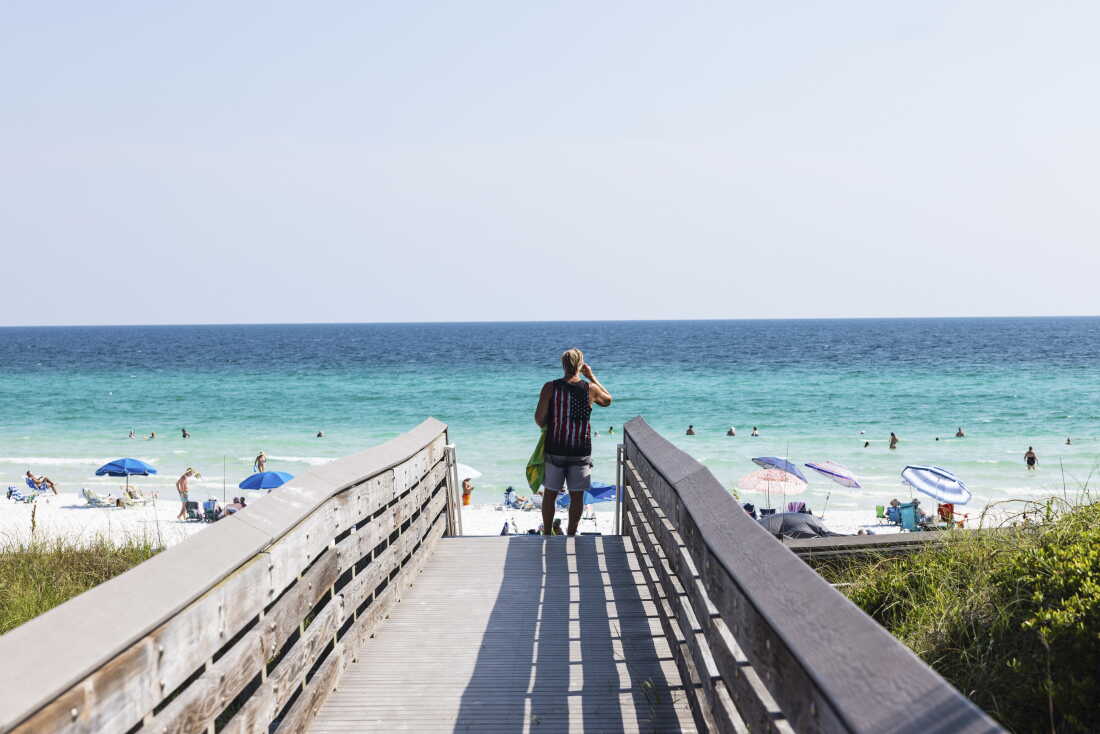
SANTA ROSA BEACH, Fla. — Walton County, with its 26 miles of scenic shoreline, has become a focal point in a contentious struggle between private property rights and public beach access. Nestled along the state Scenic Highway 30A, the area is known for its stunning beaches, featuring emerald waters and soft, white sand. However, this idyllic setting is at the center of a legal and social dispute concerning beach accessibility.
Over the past decade, disagreements over personal property boundaries and public beach rights have complicated access for visitors. The conflict, originating from efforts by Walton County to maintain public beach access against opposing property owner rights, has led to a confusing network of public and private areas.
Dave Rauschkolb, founder of Florida Beaches for All, advocates for open beaches. He describes how “No trespassing” signs and security staff frequently line the beaches, maintaining private property boundaries. Rauschkolb, who grew up surfing in the area and owns a local restaurant, criticizes owners limiting beach access.
“We’re fighting for the right for people to set up on any beach,” Rauschkolb says.
Conversely, Eric Wilhelm, a beach homeowner, argues that this encroaches on personal property rights. Wilhelm, along with several landowners, has engaged in legal battles with Walton County. These disputes erupted when the county passed a customary-use ordinance asserting public rights over traditionally used beaches. The ordinance faced opposition from politically influential individuals, leading to a state law requiring the county to legally prove customary use.
Attorney Kent Safriet represents landowners, arguing that customary use concept from English law conflicts with the U.S. Constitution. Safriet insists the struggle is about control between property owners and the county. Despite the repeal of the controversial law, ambiguity remains, leaving Walton County Sheriff Michael Adkinson Jr. and his deputies caught amid ongoing disputes.
The local community sees a growing call for a constitutional amendment to ensure public beach access, reflecting similar laws in other states. Beach activist Sara Day developed an app called Shoreline Defender to help people determine public areas based on tidal lines. Day’s app arose from her personal experiences with restrictive beach access.
Linda Miller, a real estate agent in the area for nearly three decades, observes the impact of limited beach access on the housing market. “Everybody wants to be here,” she notes, pointing out the county’s rapid population growth and tourism influx.
While some suggest solutions like a beach-share program in exchange for tax incentives, public advocates continue to push for statewide legislative changes prioritizing beach accessibility. “If there ever was a state where public beaches should be guaranteed, it should be Florida,” Rauschkolb asserts.