
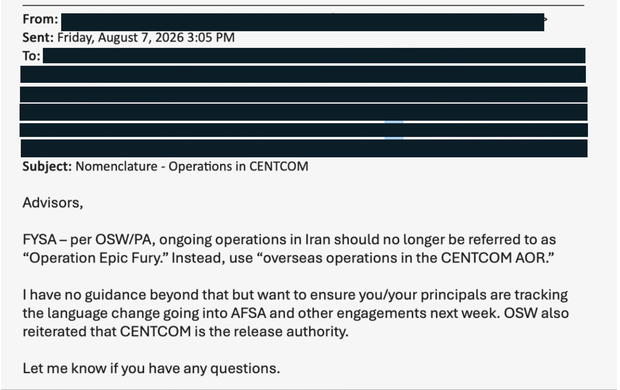
An Air Force communication from August, obtained by CBS News, revealed the Pentagon instructed personnel to discontinue the use of ‘Operation Epic Fury’ to describe U.S. military undertakings in Iran. This instruction came months after the Trump administration claimed the operation had concluded.
The Pentagon confirmed Operation Epic Fury officially ended on May 5. On the same day, Secretary of State Marco Rubio announced the operation’s conclusion at the White House, stating, ‘The operation is over.’ This marked a transition to ‘Project Freedom.’
The official end of the operation came after months of silence from the Pentagon and U.S. Central Command about the formal conclusion date. Despite the official end, sporadic conflicts between the U.S. and Iran have persisted, with significant pauses, including a ceasefire beginning in early April.
The delayed determination of the operation’s end raises questions about the classification of American service members killed or wounded in subsequent operations. Additionally, high-level public affairs officers were told to refer to ongoing conflicts using ‘overseas operations’ rather than the Operation Epic Fury moniker, according to an August 7 email from the central public affairs office led by Sean Parnell, the chief Pentagon spokesman.
This guidance was not limited to the Air Force. Military officials reported the directive was disseminated widely across the Defense Department in August and September.
Following the April ceasefire, the Pentagon stated that subsequent military actions included navigational operations and strikes focusing on reducing threats posed by the Islamic Revolutionary Guard Corps. These details indicate continuous military activities beyond Operation Epic Fury.
Historically, the U.S. military publishes the start and end dates of named military operations to establish formal records of military engagements. These records help track American military involvement.
Rubio was the sole Trump administration official to explicitly declare the conclusion of Operation Epic Fury, but he didn’t specify May 5 as the end date. Furthermore, on May 5, Defense Secretary Pete Hegseth briefed reporters at the Pentagon, highlighting Project Freedom, a maritime mission designed for commercial shipping protection, differentiating it from Epic Fury.
Despite the conclusion of Operation Epic Fury, U.S. and Iran-related military activities have continued. President Trump informed Congress that military actions restarted with Iran in early July, following failed negotiations and the collapse of the April ceasefire.
Iranian forces have sustained attacks on U.S. forces, leading to periodic U.S. retaliations. These ongoing activities led to questions about the necessity of the guidance to avoid ‘Operation Epic Fury’ in communications, months after its formal conclusion.
The importance of the May 5 benchmark extends to understanding how military casualties are categorized. In July, a Defense Department website initially listed four service members, killed in July, as casualties of Operation Epic Fury. Among them, 1st Lt. Tyler James Feehan, Staff Sgt. Angel Rampersad, and Pfc. Isabella Gonzales were killed in an attack in Jordan, while Staff Sgt. Michael Emmanuel Swinton died in Iraq.
These casualties were later reclassified under ‘overseas operations’ in late July, reducing the number of fatalities directly associated with Epic Fury. Chief Pentagon spokesman Sean Parnell attributed initial misclassifications to a ‘temporary data disruption.’
Currently, the Defense Casualty Analysis System reports additional casualties previously categorized under Operation Epic Fury, though the official end date remains absent from records.