
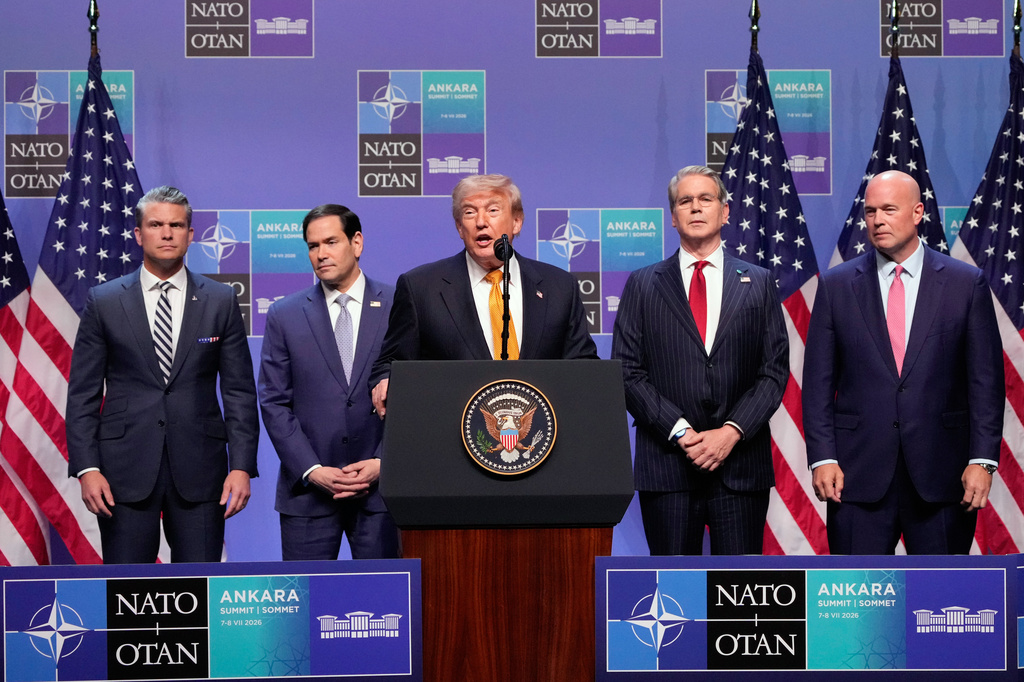
President Donald Trump recently spoke at the NATO summit in Ankara, Turkey, surrounded by key figures such as U.S. Defense Secretary Pete Hegseth, U.S. Secretary of State Marco Rubio, U.S. Treasury Secretary Scott Bessent, and U.S. Ambassador to NATO Matthew Whitaker. During this conference, the importance of global military readiness was highlighted with emphasis on the ongoing conflicts and resources.
Historically, Russia has pursued its political goals through military aggression, as seen in the invasions of Georgia in 2008, Crimea in 2014, and the full-scale assault on Ukraine. Russia’s actions have consistently shown an imperial rather than defensive intent. The country’s drive to maintain a wartime economy, willingness to accept high casualties, and endure severe sanctions underlines its determination. Such behavior poses a serious threat to fragile democracies, especially in Eastern Europe where nations like Poland and the Baltic states find themselves increasingly pressured.
Effective counteractions require Europe’s commitment to fill strategic gaps left by the reduction in Pentagon forces on the Eastern Frontier. In parallel, China employs a different set of tactics such as economic coercion and cyber activities to extend its global influence. Yet, despite its bold rhetoric on Taiwan, China has refrained from major military operations, emphasizing deterrence and information dominance over outright warfare.
While China possesses advanced weaponry and substantial forces, the absence of combat experience raises questions about its capability to conduct large-scale invasions. An attack on Taiwan would likely unite Western powers against Beijing, severely impacting its economy and internal stability. Therefore, maintaining strong alliances in the Indo-Pacific is crucial for the U.S., alongside strengthening freedom of navigation.
The imperative of strategic prioritization lies not only in preparing for potential conflicts but also addressing current, active threats. Europe has been a bastion of Western democracy, defending against tyranny and fostering peace and prosperity, owing largely to U.S. leadership and NATO unity. Today, with heightened tensions not seen since the Cold War, Europe’s strength is vital.
The U.S. must affirm its security commitment to Europe as a clear deterrent against adversaries like Russia, which aims to weaken NATO. Prompt action, strategic clarity, and fortified Eastern defenses are essential. Modernizing command infrastructure serves as a robust deterrence against aggression.
Current defense strategies are overly focused on potential conflicts with China. Concurrently, stockpiles are depleted in ongoing European and Middle Eastern conflicts, revealing gaps in the defense industrial base. To maintain global leadership, rebuilding this capacity in response to actual threats is critical. Support for NATO not only aids Europe but strengthens deterrence globally, showing resistance to aggression.
The U.S. Army and Air Force need increased investment for effective defense of the European theater through air and land dominance, expedited logistics, and intelligence coordination. Rebalancing resources is essential for readiness in these domains.
A unified NATO deters China indirectly, reinforcing peace in the Pacific. Misaligned military strategies could lead to dire consequences. Russia is actively altering borders through conflict, testing global resolve rather than China’s ambitions. It is crucial to confront Russian aggression decisively, strengthening European allies and addressing strategic challenges before they escalate.
Keith Self, representing Texas’s 3rd District, serves on the House Foreign Affairs and Veterans’ Affairs committees and chairs the Europe Subcommittee. With 25 years in the U.S. Army, his insights draw from extensive experience.
© 2026 Nexstar Media Inc. All rights reserved. This material may not be published, broadcast, rewritten, or redistributed.