
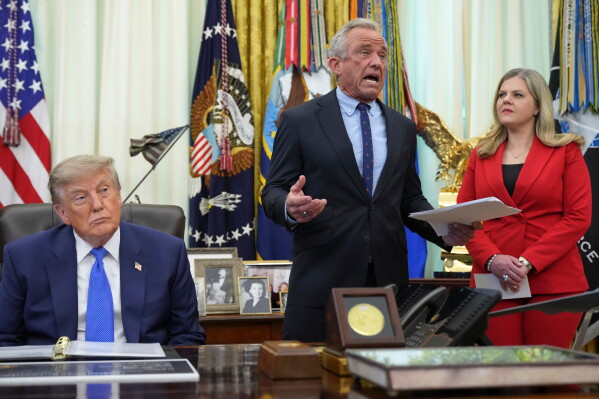
Dr. Heidi Overton, a trusted White House aide, has been nominated by President Donald Trump to lead the Food and Drug Administration (FDA). Overton, a medical doctor and deputy director of the White House Domestic Policy Council, has played a significant role in Trump’s health initiatives during his second term. Trusted for her commitment to the Republican president’s health agenda, her nomination requires Senate confirmation. If confirmed, she would need to juggle diverse priorities, ranging from Trump’s goals to the anti-corporate stance of Health Secretary Robert F. Kennedy Jr.
Overton has a medical degree from the University of New Mexico and a doctorate in clinical investigation from Johns Hopkins University. Her LinkedIn profile reveals her previous role as chief policy officer at the America First Policy Institute. Known for promoting Trump’s health priorities, she has been involved in policy changes, including deals with drug companies to reduce prices and an order aimed at altering the MMR vaccine administration. While medical groups opposed this, Trump and Overton suggested an unfounded link between vaccine timing and autism spectrum disorder, despite scientific consensus proving otherwise.
Her nomination faces opposition due to her stance on abortion pills. Overton has criticized these medications and could potentially reverse FDA rules enhancing their accessibility. This aligns with the views of U.S. abortion opponents who argue that online prescription of these pills undermines state bans. Mifepristone, often used with misoprostol, constitutes a majority of U.S. medication abortions and is regarded as an extremely safe medication according to FDA approval.
The confirmation process, led by a narrowly Republican-controlled Senate, will involve scrutiny by the Senate Health, Education, Labor and Pensions Committee. Its chair, Republican Sen. Bill Cassidy, critical of some of Trump’s vaccine policies, may challenge her nomination. Democratic senators have been outspoken against Overton’s nomination, branding her as an unsuitable leader for the FDA due to her far-right views.
Dr. Marty Makary, the previous FDA head, faced various challenges during his tenure, including issues related to ultraprocessed foods, antidepressants, and COVID-19 vaccines. Flavored e-cigarettes remained a contentious topic, criticized for their appeal to teenagers. The FDA recently altered policies to permit unauthorized electronic cigarettes and nicotine pouches, bypassing expert recommendations. Biotech companies, investors, and patient groups anticipate improvements at the FDA following setbacks in drug approvals for rare diseases. Makary aimed to resolve industry concerns by endorsing programs to hasten drug approvals, although these initiatives brought additional challenges.
Overton must address Kennedy’s ‘Make America Healthy Again’ initiative, with its supporters expressing skepticism about her suitability. Activist Kelly Ryerson criticized Overton’s remarks about pesticides at a White House event, labeling them as echoes of manufacturer Bayer’s rhetoric. Regulatin peptides is also on the agenda, with federal advisers recommending easier access despite FDA warnings regarding safety and efficacy.
The FDA is reviewing policies, including a rule requiring food manufacturers to notify authorities of new ingredients in processed foods. Alongside, they work on defining ultraprocessed foods, believed by Kennedy to contribute to chronic health issues. With vaccine testing constraints, and previous orders challenging childhood vaccination processes, the FDA manages various ongoing investigations on foodborne illness outbreaks linked to contaminated lettuce and jalapeño peppers.
Support from the Howard Hughes Medical Institute’s Department of Science Education and the Robert Wood Johnson Foundation aids the Associated Press Health and Science Department. The AP maintains sole responsibility for its content.