
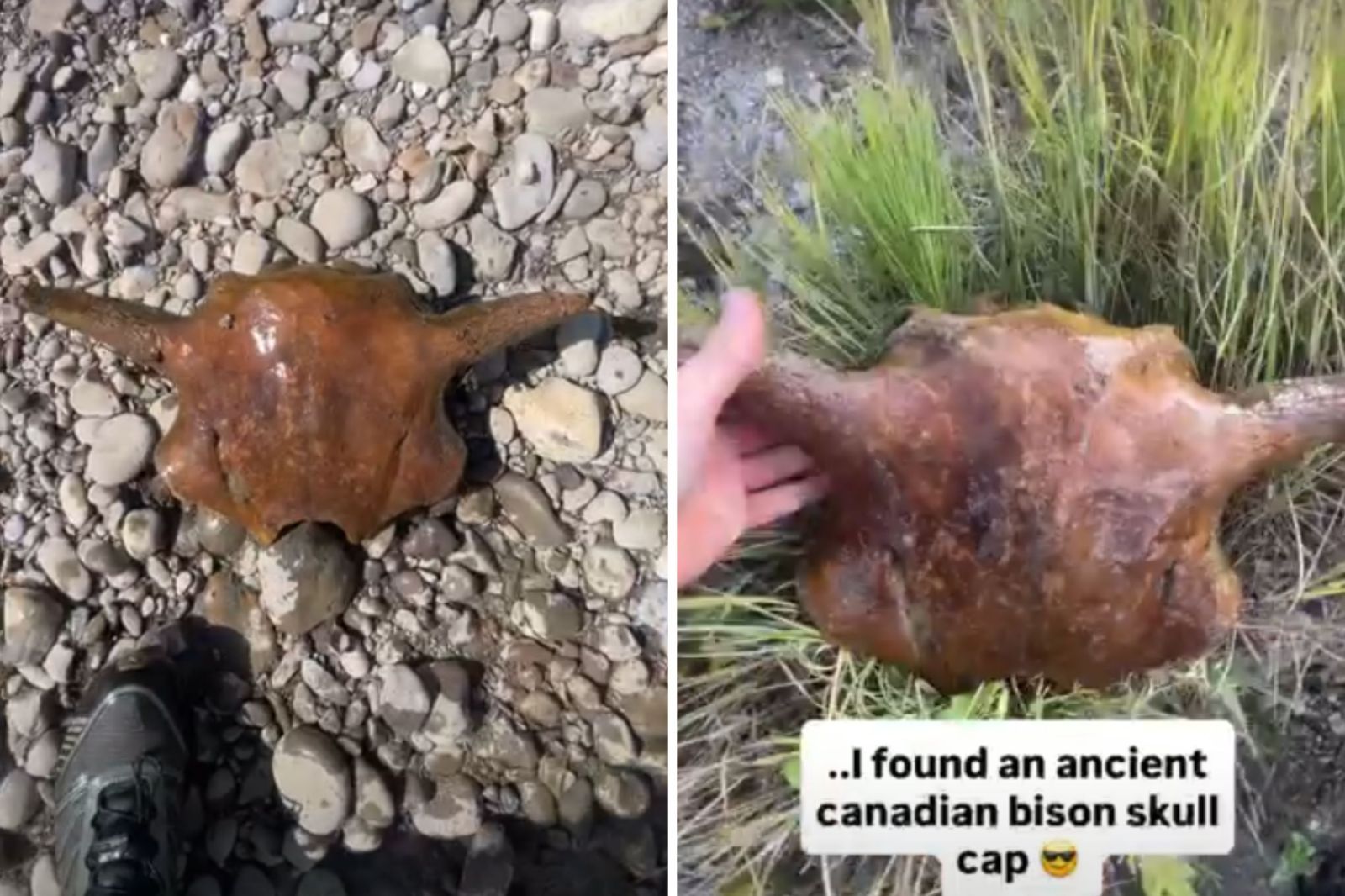
A man fishing in Alberta, Canada, made an unusual discovery while exploring a creek. Dominic Boon, residing near Banff, often looks for intriguing objects during his outdoor adventures. This recent find while fly fishing proved unique.
Boon noticed an object in the water and decided to record the scene. He later shared the footage on his Instagram, @dominicboon_. Initially, his companions thought it might be a cow skull, but Boon felt differently.
Heavy Rain Reveals the Skull
Boon’s instincts were confirmed the next day. Experts identified the object as a bison skull. A pressing question remained: how long had it been there?
The discovery followed a summer of unusual rain. According to The Canadian Press, Alberta’s capital experienced its wettest summer on record. Boon speculated that heavy rain uncovered the skull, potentially buried for years.
The skull weighed several kilograms. Its condition suggested it might be older than recent animal remains.
A 5,000-Year-Old Mystery
Boon consulted museum experts, receiving an email from Dr. Chris Jass of the Royal Alberta Museum. The curator confirmed it as a bison skull. Although its exact age is unclear, an estimate suggests it could be as old as 5,000 years. The youngest the skull might be is around 150 years old.
Rapid burial could explain its preservation. The U.S. National Park Service notes that burial protects remains from scavenging and weathering.
Boon plans to bring the skull to the museum for further analysis. Experts aim to measure, weigh, scan, and photograph it to learn more.
A Species Nearly Lost
This find relates to a species nearly driven to extinction in Alberta. The Canadian Parks and Wilderness Society reports that plains bison once numbered over 30 million across North America. By the late 1880s, they nearly vanished from Canada due to overexploitation and habitat loss. Similarly, the wood bison population dropped drastically.
Today, Alberta has approximately 2,800 wild wood bison roaming freely. Plains bison occupy a fraction of their historic range. This history makes the skull’s discovery significant, even though its age is yet to be confirmed.
Whether the skull is 150 years old or several millennia, the context of its discovery adds intrigue, according to Boon.