
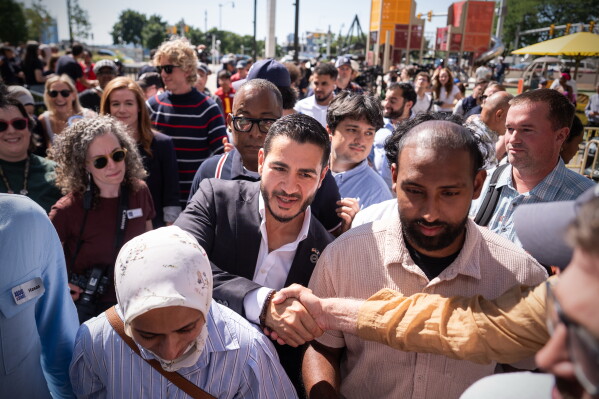
Abdul El-Sayed, a former public health executive, has secured a narrow victory in the Michigan U.S. Senate primary, defeating Rep. Haley Stevens. El-Sayed will now compete against Republican Mike Rogers, a former congressman, in the upcoming November election. This race is pivotal in determining control of the Senate.
El-Sayed’s challenge is to unite Democratic factions following a divisive primary. Though Stevens, backed by Democratic stalwarts like outgoing Sen. Gary Peters, conceded and expressed her support for El-Sayed. The primary revealed contrasting visions within the party.
El-Sayed campaigned on progressive issues, promising to tackle corporate interests and former President Donald Trump emphatically. Despite a tight victory margin, less than 1% with just under 15,000 votes, he proclaimed a political milestone, echoing Muhammad Ali’s sentiment of ‘shaking up the world’.
The Associated Press confirmed El-Sayed the winner after updates from Wayne and Oakland counties showed Stevens couldn’t bridge the gap.
Backing El-Sayed were figures like Sen. Bernie Sanders and Rep. Alexandria Ocasio-Cortez, pushing for grassroots movements against establishment politics and significant monetary influences.
“El-Sayed’s win should alert the Democratic establishment in Washington,” said Sen. Chris Van Hollen.
El-Sayed’s progressive platform included ‘Medicare for All’, cutting military aid to Israel, and reforms in campaign financing. Such elements attracted diverse support, highlighting the evolving dynamics within the party.
After Stevens’ petition withdrawal, unification becomes crucial. Curtis Hertel, the Michigan Democratic Party chair, emphasized collaboration to ‘take the country back’ facing Rogers.
Given Michigan’s pivotal Senate race status and during the last phase of Trump’s tenure, Democrats face heightened pressure. Moderates voiced concerns over El-Sayed’s general election viability compared to Stevens, who touted her manufacturing and economic focus.
Stevens, a four-term congresswoman initially elected in 2018, highlighted her resilience in tough elections, challenging her opponent’s anti-establishment rhetoric.
Voters showcased differing concerns. Kenneth Woodside, 87, backed El-Sayed for advocating assertive changes against oligarchical and authoritarian trends, while Nessa Fuller, 51, favored Stevens due to her collaborative approach.
Outside spending reached significant levels as groups spent over $50 million, with substantial contributions from pro-Israel groups like the AIPAC supporting Stevens. These financial dynamics underscore contentious debates on military aid to Israel within Democratic circles.
As the primary nears conclusion, outside influences like the AIPAC pledged opposition towards El-Sayed’s perceived anti-Israel stance.
In a Detroit congressional primary, state Rep. Donavan McKinney defeated Rep. Shri Thanedar in a district with historical Black representation, aiming to reinstate it after its absence since the early ’50s.
AP reporters Nathan Ellgren and Jesse Bedayn contributed to this coverage.