
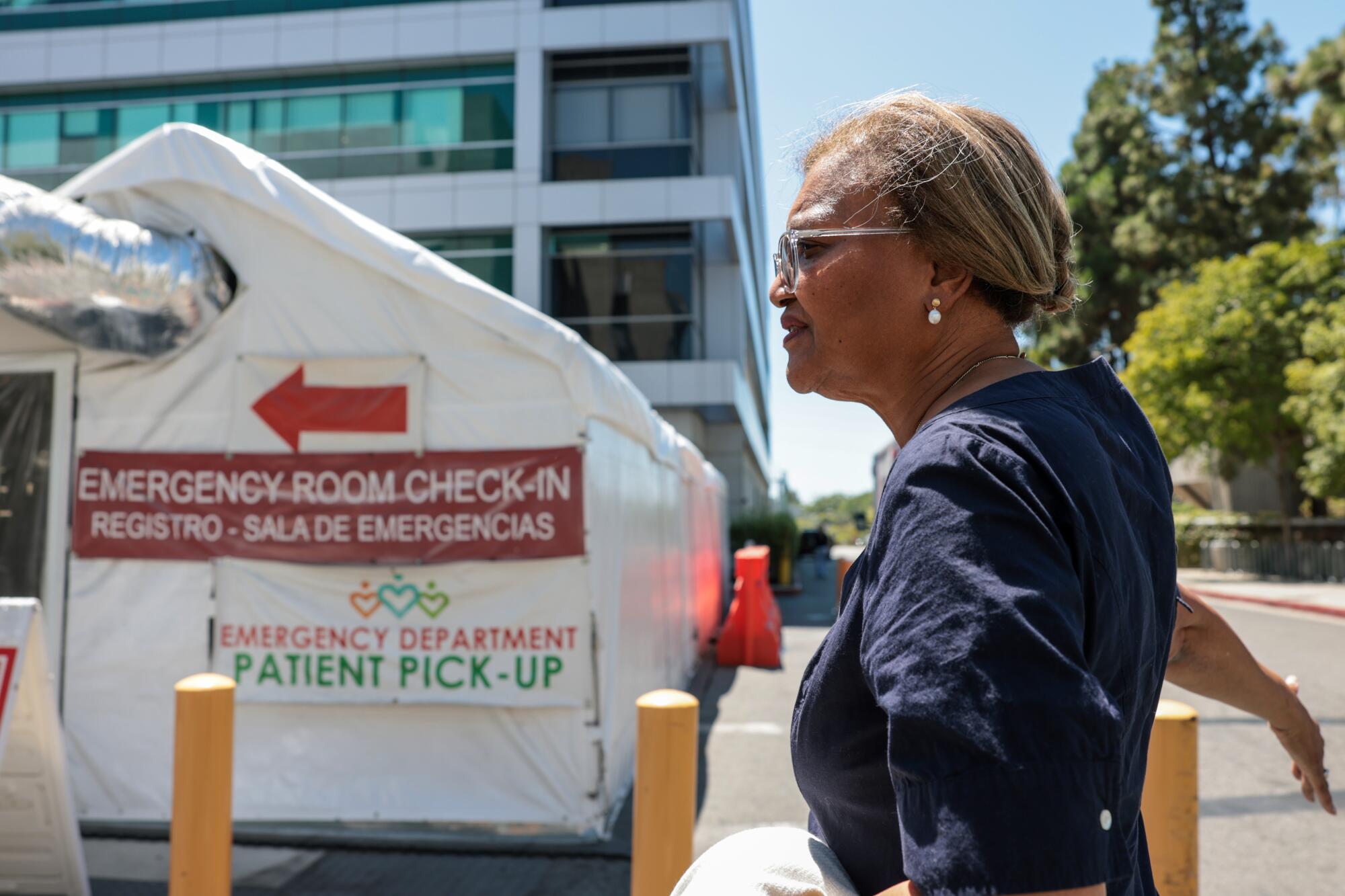
Martin Luther King Jr. Community Hospital in Willowbrook faces significant challenges as the main provider of emergency medical care for many South Los Angeles residents. Due to limited space, many patients receive treatment in large metal-frame tents outside the facility. This situation echoes the makeshift medical care settings seen during the early COVID-19 pandemic.
The hospital’s financial difficulties have intensified. Last fiscal year, the hospital reported a net income of $14 million but had operated with a deficit during the previous three years. The facility anticipates a loss of $80 million to $100 million annually due to Medicaid changes mandated by HR1 in 2025. Tony Weiss, media relations director at MLK Community Healthcare, emphasized the deep financial challenges during a hospital tour, describing them as ‘crazy.’
Hospital leaders are urging the Los Angeles County Board of Supervisors to reconsider fund allocation from Measure B, which is a property tax levy. This measure generated approximately $427 million in fiscal year 2025 to support trauma centers, emergency services, and bioterrorism response, benefiting county and private hospitals with trauma centers. Conversely, private hospitals without trauma centers, like MLK, must compete for excess funds beyond county projections.
From 2023 to 2025, MLK was bailed out with $68 million from the state and county, including $29 million from Measure B’s ‘leftover’ funds. The hospital, a private nonprofit since 2015, hasn’t qualified for ongoing Measure B funding. In contrast, 13 private hospitals with trauma centers received $126 million in Measure B funds last fiscal year. Among them, Cedars-Sinai Medical Center, a top U.S. hospital reporting $1.1 billion net income on $5.8 billion revenue, is allocated significant Measure B funds but opposes changes to the distribution model.
Cedars-Sinai’s Stephanie Cohen argues that altering fund allocation could undermine Measure B’s intended purpose. A Cedars-Sinai spokesperson, Sally Stewart, stated changes risk destabilizing the system. Weiss from MLK calls the financial disparity ‘a tale of two hospitals.’ In MLK’s overcrowded emergency department, patients are treated in hallways, repurposed rooms, and under tents; the hospital is unable to expand its emergency department due to funding limitations.
Dr. Elaine Batchlor, MLK’s CEO, points out the critical need to reassess Measure B funding. She highlights the financial struggles shared by MLK patients and suggests reallocating funds to communities with greater healthcare needs could support hospitals at risk. Dr. Naman Shah from the L.A. County Department of Public Health notes past allocations did not reflect the economic realities of county healthcare.
If MLK hospital closes, it would significantly impact healthcare access for one of the region’s financially insecure communities. MLK served nearly 85,000 Medicaid/Medi-Cal emergency department visits in 2023, the highest in the state. In fiscal year 2025, 95% of its patients were on Medicaid/Medi-Cal, Medicare, or uninsured, making state and county funding crucial, as patient revenue constitutes only 44% of its budget.
Local leaders like Pastor Robert Taylor of Beulah Baptist Church advocate for better resource distribution to meet community needs. Los Angeles County Supervisor Holly Mitchell, representing Willowbrook, plans to propose hiring a consultant to review Measure B allocations to ensure fair distribution and maintain a robust emergency care system in the county.