
When Annette Hansen learned about the federal concerns with Indiana’s wetlands program, she experienced deep discomfort. “Especially when you’re somebody who was out here in the trenches trying to take care of just a small piece,” said Hansen, Executive Director of Porter County’s Izaak Walton League of America. “We helped restore 150 acres, but that’s such a tiny, little postage stamp compared to when I look around and see what’s happening.”
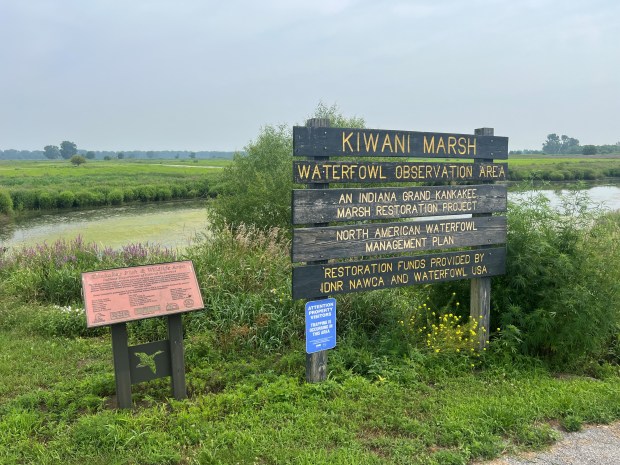
The Kiwani Marsh, spanning over 125 miles of revitalized wetland in Starke County near San Pierre, is managed by the Indiana Department of Natural Resources (DNR) as a waterfowl observation area and part of a restoration project from 2010 for the Indiana Grand Kankakee Marsh.
The Indiana Capital Chronicle reported that the U.S. Army Corps of Engineers — responsible for regulating the program — found the Indiana DNR’s wetlands program had not adhered to its “three-growing-season timeframe in all service areas.” According to the Capital Chronicle, the DNR received at least $109 million in wetlands payments from landowners, but many projects meant to offset disturbances have lagged since the program’s 2018 launch.
The wetlands program, officially known as the Indiana Stream and Wetland Mitigation Program, allows developers to buy stream and/or wetland mitigation credits to meet compensatory mitigation requirements under various federal and state laws, according to the DNR’s website.
“DNR will complete all approved and ongoing stream and wetland projects,” a DNR spokesperson stated in an email to the Post-Tribune, including three projects in Northwest Indiana. “We have three projects in the Calumet Dunes Service Area, with two expected to begin in 2027, and the third in 2028 pending Army Corps approvals.”
Hansen said Porter County’s Izaak Walton League finished a wetlands restoration project years ago, thus they face no compliance issues with the DNR’s program. They established the Frame Family Little Calumet Conservation Area, restoring it to a higher quality and removing invasive species, which helps with local drainage issues, especially on farms and lands prone to holding stormwater.
“By creating these spaces, we’re helping the community hold water,” Hansen commented, emphasizing the importance of wetland restoration in minimizing stormwater buildup given increased flood risks linked to climate change.
The DNR routinely inspects the property to ensure no buildings are placed or land sold, Hansen noted. She stressed that wetlands are vital for local communities to prevent stormwater accumulation and highlighted the growing need for restoration amid statewide land development.
Concerns about more development choices prioritizing financial gain over land and community welfare were echoed by Hansen, lamenting the decreasing protection efforts for wetlands.
The Army Corps’ Chicago District deferred request handling to the Louisville District, responsible for managing Indiana’s wetlands program. A statement explained the Corps found the program non-compliant after a 2025 review, noting issues with initial physical and biological improvements, credit delivery, and costs.
The statement mentioned the Corps directed the ILF Program to provide a Corrective Action Plan for areas not meeting standards, and continues to work with the DNR ILF Program to enhance project review timelines and ensure timely mitigation credit delivery.
The statement also covered Indiana’s data center development impacts on wetlands, a concern for both Hansen and Susie McGovern from the Hoosier Environmental Council. Data center development needs Department of Army authorization if activities discharge fill material into U.S. waters, including wetlands. Mitigation may be required, and purchasing ILF credits is one option among others.
McGovern stated data centers pose a “primary threat” statewide, benefiting from a streamlined permitting process. The Trump administration encouraged data centers with executive orders aimed at easing regulations, she added. McGovern voiced worries about wetlands vanishing without replacements.
Wetlands offer vital ecosystem services such as flood mitigation, water purification, groundwater recharge, and wildlife habitats. “Somewhere near 30% of endangered, rare, and threatened species rely on wetlands during their lifecycle,” McGovern said, urging Indiana activists and residents to appreciate wetlands’ replacement and restoration necessity.
She hopes the importance of wetlands will be recognized during business decision-making by state and local officials, seeing substantial economic prospects in wetlands preservation and conservation.