
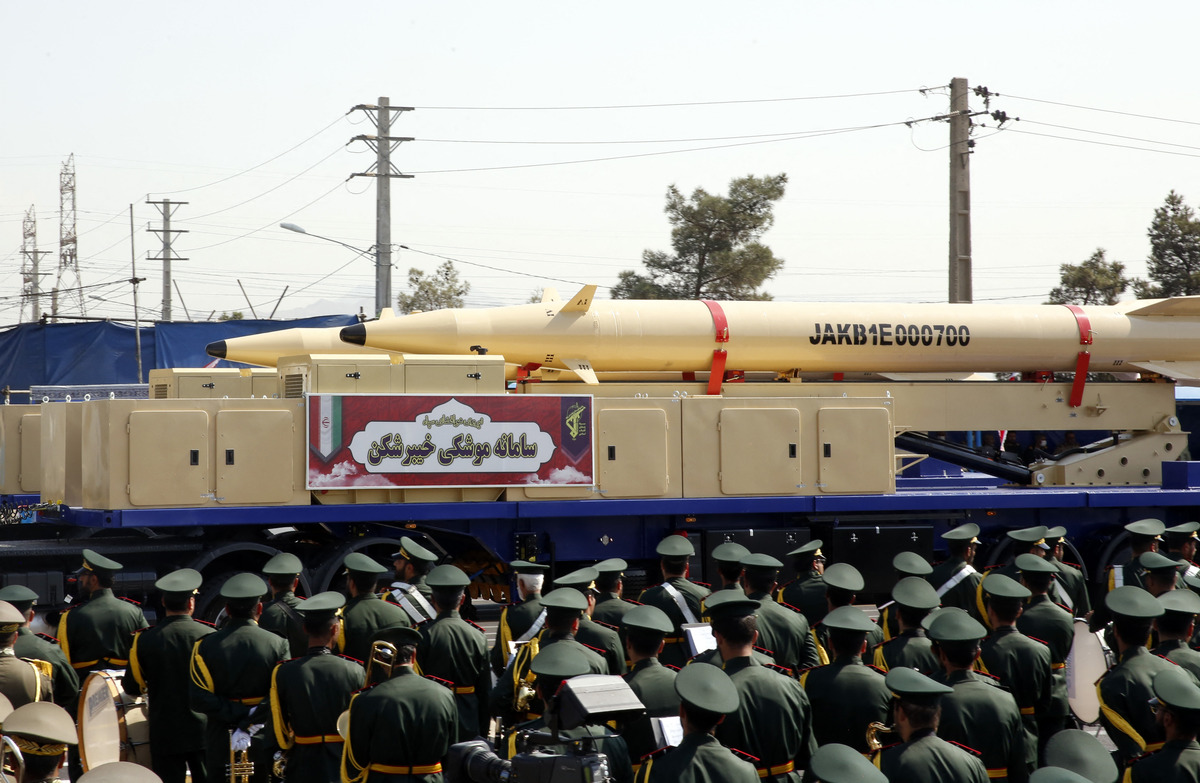
Iran has altered its military strategies using Kheibar Shekan ballistic missiles to target U.S. bases across the Middle East. This change involves modifications in the missiles’ flight paths, speeds, and mid-air maneuvers, aimed at breaching American air defenses. Reports from unnamed U.S. officials, shared with The Wall Street Journal, indicate that these adjustments have been in response to a series of missile attacks on American facilities in multiple Middle Eastern countries since early July. These actions have tested a fragile ceasefire established in June, resulting in a brief period of escalation, followed by relative calm.
On Friday, President Donald Trump commented that the U.S. is engaged in negotiations with Iran and maintains the possibility of resuming military strikes. The U.S. paused its military operations against Iran for two consecutive days, while Iran similarly suspended its attacks, according to an Iranian army spokesperson on state television.
The recent escalation by Tehran included an attack on the Muwaffaq Salti Air Base in Jordan. This strike resulted in the deaths of three U.S. service members: 1st Lieutenant Tyler James Feehan, Private Isabella Gonzales, and Sergeant Angel Rampersad. Additionally, Sergeant Michael Emmanuel Swinton lost his life due to a drone explosion at Erbil Air Base in Iraq. These incidents have raised the death toll of U.S. personnel in the conflict to 18. In recent weeks, Iran has also targeted U.S. facilities in Kuwait, Bahrain, and Qatar.
Overview of the Kheibar Shekan
Introduced by Iran in 2022, the Kheibar Shekan is an intermediate-range ballistic missile with an approximate range of 900 miles. This range puts various regions, including the Middle East, segments of Russia, India, and Turkey, within its striking capacity. The missile is launched from mobile ground platforms and uses solid fuel, allowing faster preparation and launch times compared to liquid-fueled systems, thus reducing the period during which opposing forces can target the launch sites.
The missile’s name, Kheibar Shekan, is derived from the Battle of Khaybar, a historical event in 628 when the Prophet Muhammad’s forces conquered the oasis of Khaybar from Arabian Jews.
Weighing less than earlier models to enhance travel distance, the Kheibar Shekan is part of Iran’s arsenal alongside other solid-fueled systems such as the short-range Zolfaghar and the medium-range Fattah-1, which is claimed by state media to be a hypersonic weapon.
Significance and Impact
U.S. officials noted that Iran has integrated the use of Kheibar Shekan missiles with jet-powered drones, showcasing a shift in tactical strategy. Though Tehran has not disclosed official cost figures, the missiles are thought to be substantially less expensive relative to U.S. interceptors, which can range from several million to $15 million each. Defense analysts highlight the sustainability issues posed by the continuous use of costly interceptors against cheaper incoming missiles.
“The Iranians have realized the benefits of the Kheibar Shekans due to their affordability, launch system flexibility, and effectiveness,” stated Nicole Grajewski, an Iranian strategy expert at Sciences Po in Paris.
In parallel developments, Ukrainian President Volodymyr Zelensky accused Russia of using satellites for reconnaissance on U.S. bases in the Gulf, sharing intelligence with Iran. Zelensky claimed there is an observable correlation between Russian satellite imagery and Iranian strikes on airbases in Bahrain, Jordan, and Kuwait.
Challenges for Air Defenses
Although U.S. and allied forces have intercepted most Kheibar Shekan missiles fired since the conflict began in February, some missiles have managed to evade defense systems, according to a U.S. official. Fabian Hinz, an independent missile expert, explained that Iran has refined its tactics to effectively breach missile defense systems.
Ballistic missiles pose more challenges for interception compared to cruise missiles due to their unpredictable trajectories and higher speeds. The reentry vehicle of the Kheibar Shekan, carrying the warhead during the last phase of flight, can maneuver to avoid air defenses.
There is also a tactic of overwhelming air defenses, rather than relying solely on precision, employed by Iran in its missile strikes. Qasid Mahmoud, a retired Jordanian military lieutenant general, indicated that Iranians use simpler missiles to overwhelm radar systems, followed by launching more advanced missiles that can alter their target course in the last kilometers.