
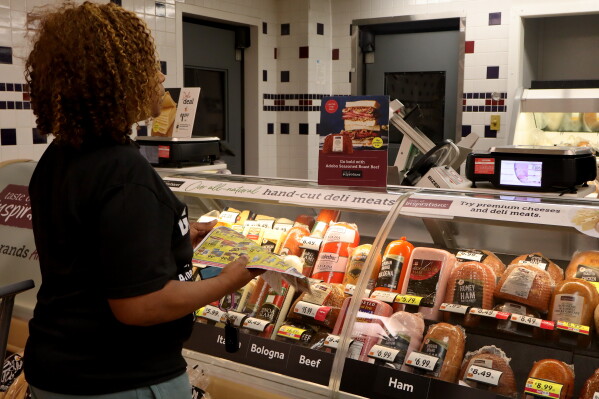
What’s for dinner? At Apral Jack’s house, it’s whatever is on sale. Jack uses an app to find deals at her local grocery store before setting out to shop. Upon arrival, she picks up the weekly circular to find additional coupons she may have missed. If prices seem steep, she scratches items off her list or searches for better prices elsewhere.
“The apples went up here, the ones I eat, so I’m not going to get them here. I’ll go to Market Basket, where I can get them cheaper,” said Jack, 50, pushing a cart into a Stop & Shop in Lexington, Massachusetts.
Couponing, comparison shopping, and cutting back on favorite foods are new practices for her and millions of other Americans as grocery prices see their largest jump in fifty years. Government figures show that buying food to eat at home has become 33% more expensive in U.S. cities since 2019. In the preceding seven and a half years, prices rose only 6.4%.
Causes of Price Increases
The historic price increase results from various factors. The coronavirus pandemic disrupted supply chains and increased labor and transportation costs. Droughts, hurricanes, and diseases like bird flu lowered production levels. Tariffs have heightened prices on foreign goods like coffee, tomatoes, and chocolate. Additionally, the ongoing Russia-Ukraine war has affected oil and fertilizer supplies.
A recent conflict in the Middle East is pushing food price inflation up again in 2026. Filling refrigerators, freezers, and pantries has frustrated many Americans and made affordability a key issue in the fall midterm elections.
Earnings vs. Grocery Prices
By some measures, Americans are slightly more capable of managing higher prices. Full-time workers’ weekly earnings have grown slightly faster than grocery costs since 2019, according to the U.S. Bureau of Labor Statistics. However, consumers recall when their money stretched further, stated Jared Bernstein, a senior policy fellow at the Stanford Institute for Economic Policy. Wages once outpaced grocery prices much more swiftly before the pandemic, Bernstein noted.
“People have a well-honed sense of those prices, just as much as gas and maybe more so,” Bernstein said.
In 2024, Americans spent an average of 12.9% of their pretax incomes on eating out and at home. For the lowest-earning fifth of U.S. households, that figure was 33%, according to the U.S. Department of Agriculture. Prices can also vary by region. For instance, food for home use in St. Louis cost 2% more in June compared to a year earlier, but in San Francisco, it was 6%.
Regional Repercussions on Shopping Habits
Residents in urban areas with above-average food price inflation have adapted by hunting for discounts, switching brands, and relying on food banks. Some people now avoid nonessentials like takeout coffee, and others buy less meat or less food overall.
“It’s almost like a household strategy where financial pressure hasn’t disappeared,” said Sally Lyons Wyatt, a global executive vice president at market research company Circana.
Meat as a Luxury
In Texas, the state with the highest beef production, meat has become a luxury for many. According to Bureau of Labor Statistics data, a pound of ground beef reached $6.82 in June, 79% more than in early 2019. A shrinking cattle herd, drought in the West, and elevated feed and fuel costs contribute to the increase.
Ada Torres, 60, lives in Cleveland, Texas, with her 36-year-old daughter and three grandchildren. With the rising cost of ground beef, their diet focuses more on chicken and cold cuts as protein sources. “Prices are sky-high,” Torres describes.
Adjustments Across the Country
Apral Jack, a resident outside Boston, Mass., now shops more cautiously than before. She starts by checking an app for deals and digital coupons. Her strategy involves planning meals based on sales.
In San Francisco, Jack Chang, a self-employed barber, hasn’t gone out for boba tea or artisanal ice cream. Chang’s family economizes with generic brands of food and medicine while benefiting from food assistance through SNAP.
In Hawaii, Amanda Tabadero, a pastry chef, experiences higher grocery costs due to the expenses involved in shipping goods to the islands. This affects price selections, leading her to seek more affordable alternatives at large chains like Costco rather than local stores.
This report is a collaboration between The Associated Press, The Lexington Observer in Massachusetts, La Esquina in Texas, and Honolulu Civil Beat in Hawaii.