
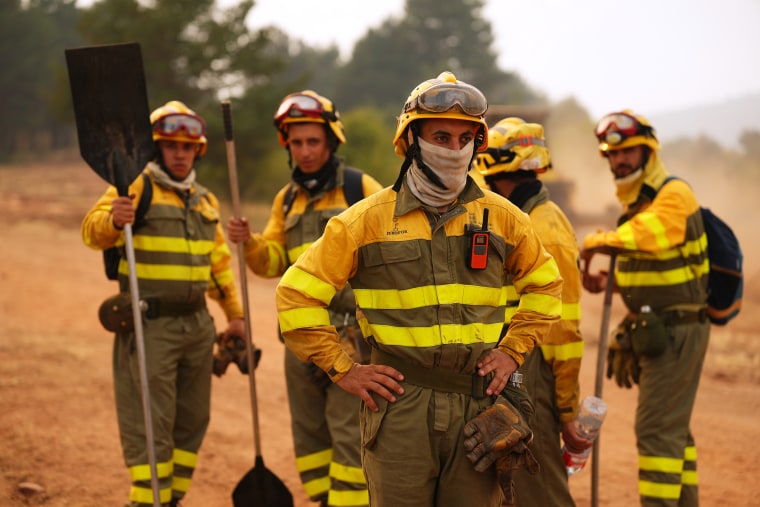
Spain declared a national emergency Friday as wildfires led to the evacuation of about 10,000 people in the central Madrid region. Simultaneously, southern France witnessed tens of thousands evacuating to escape two significant fires.
The national emergency places Spain’s interior ministry in charge of coordinating firefighting efforts. Regional firefighting teams are struggling with various blazes under extreme heat conditions. Madrid’s regional authorities reported that several villages saw evacuations due to wildfires spreading uncontrollably late Thursday.
Spain has experienced roughly 500 square miles torched this year. This figure stands at more than four times the area burned in the first half of 2025. One major fire near Guadalajara, north of Madrid, burned 120 square miles, making it Spain’s second-largest fire in recent years. Earlier this month, a deadly fire in southern Spain claimed 13 lives, marking it as one of the most lethal in recent memory.
The national emergency means that the nation’s interior ministry has taken charge of firefighting efforts.
Spanish Prime Minister Pedro Sánchez urged for a political consensus to combat climate change. This cooperation is seen as essential for adjusting to a climate more prone to such fires. Temperatures in southeastern Spain are forecasted to reach up to 44 C (111 F).
In France, mass evacuations continued Friday on the Atlantic coast due to expanding wildfires. Approximately 40,000 individuals have evacuated over the last two days. Near the tourist spot Cap Ferret, over 34 square miles have burned since Wednesday, forcing some to escape by boat.
France called for help through the European Union’s Civil Protection Mechanism. It awaits reinforcements such as Croatian Canadair planes, Portuguese Air Tractor aircraft, and Black Hawk helicopters from the Czech Republic and Slovakia. President Emmanuel Macron highlighted this collaboration.
Southern Europe is facing numerous large fires this summer. As Europe’s fastest-warming continent, its temperatures have doubled the global rate since the 1980s, according to the EU’s Copernicus Climate Change Service. Globally, 2025 was the third-hottest year on record, causing heatwaves across Europe. Experts warn that climate change is increasing heat and dryness in southeastern Europe, raising the risk of health impacts and wildfires.