
Egypt recently announced two major archaeological discoveries that are expected to enhance the country’s tourism sector, particularly focused on its rich antiquities. Found in the western desert, a well-preserved Byzantine-era residential city at the Dakhla Oasis was one such find. Additionally, the Marina el-Alamein site near Alexandria revealed significant historical artifacts.
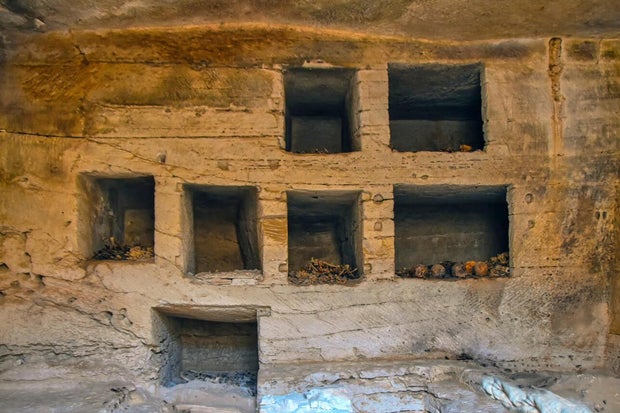
In the Greco-Roman cemetery, dating back more than 2,300 years, archaeologists unearthed human remains and numerous artifacts. Remarkably, the complete skeletons of two wild boars were found at the site, highlighting the boars’ significance as Seth, a deity linked to chaos and violence in ancient Egyptian mythology.
Tourism, alongside the strategic Suez Canal, plays a critical role in Egypt’s economy by generating foreign currency. Limestone-built tombs at the Marina el-Alamein archaeological site were among the noteworthy discoveries.
Insights into the Byzantine Empire
The Tourism and Antiquities Ministry stated that the Dakhla Oasis discovery offers insights into daily life, urban development, and economic activities during the fourth century when Egypt was part of the Byzantine Empire. Excavations reveal streets forming open squares and public spaces, according to Hisham el-Leithy, secretary general of the supreme council of antiquities.
A basilica church from the mid-fourth century stands prominently in the settlement, overlooking main streets with remnants of two watchtowers safeguarding the surrounding areas, noted Mahmoud Massoud, leader of the archaeological mission.
Among the findings was a heavily fortified structure with thick defensive walls and various houses, such as the home of Tisous, a church deacon from the late fourth century believed to have served as a house church prior to the city’s basilica construction.
Archaeologists uncovered bread ovens, kitchens, and stone grinding tools linked to food production. They also found bronze coins depicting Byzantine emperors, Latin inscriptions, Christian symbols, and gold coins from Roman Emperor Constantius II’s reign from 337 to 361.
Diaa Zahran, head of the Islamic, Coptic, and Jewish Antiquities department, reported the discovery of around 200 pottery fragments, known as ostraca, used for writing materials. These fragments include inscriptions detailing commercial transactions and correspondence, as well as private letters, laundry lists, purchase records, and literary works.
Discovery of Ancient Tombs
Separately, archaeologists uncovered 18 ancient tombs at the Marina el-Alamein site, approximately 62 miles from Alexandria. Among the findings were 11 rock-cut tombs with a depth of 26 feet and seven surface limestone-built tombs, bringing the total number of tombs at the site to 48.
Items found included pottery vessels, amphorae, lamps, plates, altars, and limestone basins. The mission chief, Eman Abdel-Khaliq, announced the discovery of an 8-foot-long granite sarcophagus with skeletal remains undergoing study. Nearby, the remains of a plaster sphinx statue were located.
Abdel-Khaliq mentioned finding four gold pieces within the mouths of some deceased, known as ‘the golden tongue,’ linked to funerary beliefs of that period.
The Marina el-Alamein site, near Alamein, is believed to have been Leukaspis, an ancient Greco-Roman port city established in the second century that thrived until the fourth century but was devastated by a tsunami.
Egypt’s tourism industry is rebounding after political instability and violence following the 2011 uprising and the impact of the coronavirus pandemic. Official figures showed 19 million tourists visited Egypt last year, a 21% increase from 2024, and the first four months of 2026 registered higher tourist numbers compared to the same period in 2025.