
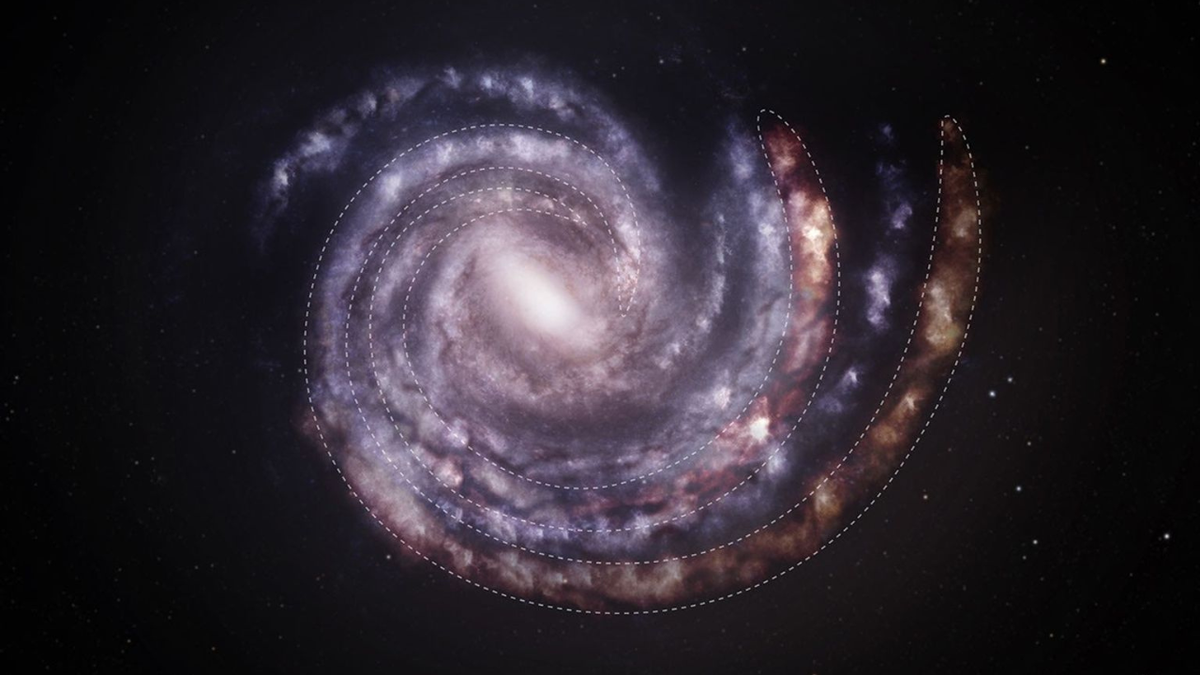
Astronomers have made a significant discovery about the Milky Way galaxy. New research reveals that the galaxy’s spiral arms might extend further into space than previously known. This breakthrough came from precise distance measurements of dust clouds in the arms, using information from NASA’s Chandra X-ray telescope and the European Space Agency’s XMM-Newton.
To achieve this precision, scientists utilized gamma-ray bursts from distant galaxies. As X-rays from these bursts travel through the Milky Way, some light reflects off dust clouds, forming measurable rings. This method offers precision rarely seen due to its reliance solely on geometry.
Beatrice Vaia, an Italian PhD student leading the study, noted, “This is a very direct way to precisely measure distances to the Milky Way’s spiral arms.” Traditional methods rely on assumptions about the galaxy’s rotation, which are less reliable in its outer regions.
Findings show that the dust cloud in the Milky Way’s most distant arm stretches approximately 3,500 light-years wide. Although astronomers have known about the galaxy’s arms for a century, mapping them has been challenging due to our location within one of them.
The use of gamma-ray bursts bypasses the limitations imposed by Earth’s position in the galaxy. Ilaria Fornasiero, a co-author and PhD student, explains, “The differences are small, but any revision is crucial for understanding our galaxy.” Altering distance estimates might require astronomers to revise the galaxy’s mass, affecting calculations of arm stretches.
However, the scarcity of suitable gamma-ray bursts presents a challenge. Only a few have been identified in the past 25 years, but the research team remains vigilant. Andrea Tiengo, a co-author, emphasized their commitment to continuing their search for more data.