
On July 6, 1776, John Hancock, president of the Continental Congress, sent a letter and copies of the new Declaration of Independence to General George Washington, who was with his army in New York. Hancock described the congress’s focus on the significant subject of independence from Britain. He highlighted that declaring independence was a duty owed to themselves and future generations, asking Washington to announce it as he deemed appropriate.
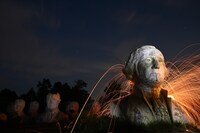
Washington’s involvement in the nation’s founding, especially the moments leading up to the 250th anniversary, highlights his continued relevance. Photographer Matt McClain captured these themes by illustrating how Washington remains a symbol of unity amid contemporary divisions.
On July 9, 1776, Washington ordered his Continental Army troops in Manhattan to gather at 6 p.m. to hear the Declaration read by their officers. In the order, Washington expressed hope that this event would motivate them, emphasizing that their country’s peace and safety depended on their military success.
The painting “Surrender of Lord Cornwallis,” located in the U.S. Capitol Rotunda, depicts the British surrender after their defeat by Washington in Yorktown, Virginia, in 1781. This marked the end of the war. Other moments, such as re-enactments at Mount Vernon and the projection of Washington on his 555-foot monument, are part of the anniversary celebrations.
According to Doug Bradburn, President of George Washington’s Mount Vernon, the reading was influential. Washington received a stack of printed declarations, likely sent by Hancock via courier, historian Emily Sneff suggests. Samuel Blachley Webb, an aide-de-camp, noted the troops’ enthusiastic response to the Declaration.
Washington wrote to Hancock the following day, affirming his men’s support for the Declaration. However, as celebrations occurred, the British prepared to send a formidable force to New York, which Washington would soon confront.
The significance of Washington’s role as a recipient of the Declaration is underscored by Sneff, who emphasized that Washington was crucial to transforming the Declaration into a reality. Despite the Declaration, victory only came with the Americans and their allies’ win at Yorktown in 1781, which was a pivotal battle that helped secure independence.
Washington’s legacy extends beyond military achievements. His visits to Colonial Williamsburg and time in the Virginia House of Burgesses reflect his connection to various American historical contexts.
In 1776, Washington could not predict the cities, monuments, and celebrations that would bear his name. Icons of American history, like his preserved dentures, family burial site, and former home at Mount Vernon, contribute to his lasting legacy.
Artifacts such as a coat of arms, a reconstruction of a period kitchen, and his office in Winchester, Virginia, reflect his influence beyond military and political spheres.
Visitors today can explore these aspects through museum tours and historical sites, such as the American Revolution Museum at Yorktown.