
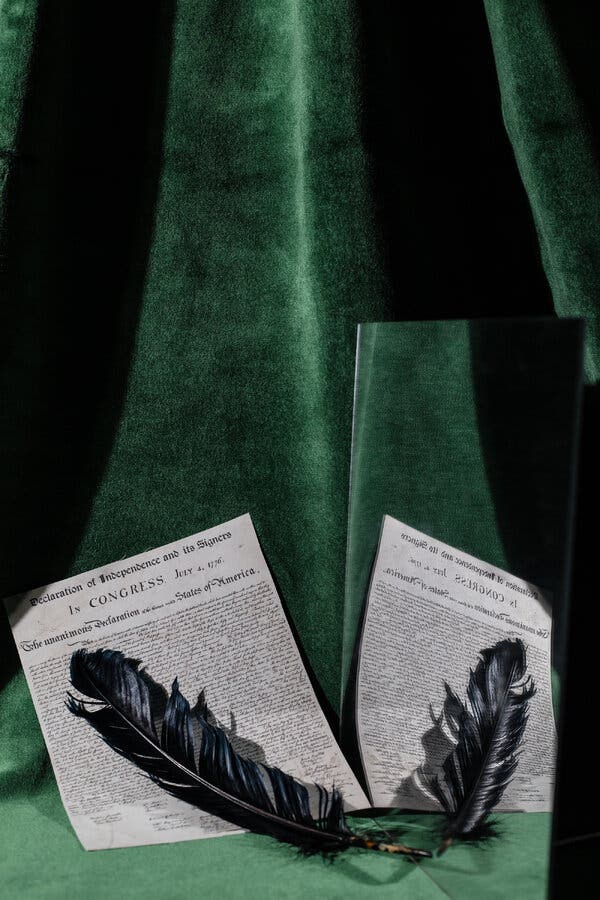
Every American encounters the Declaration of Independence at some point. To many, it appears as a sacred text of the nation’s civic values, especially its powerful message of human equality, encapsulated in the famous phrase: “We hold these truths to be self-evident, that all men are created equal, that they are endowed by their creator with certain unalienable rights, that among these are life, liberty, and the pursuit of happiness.”
The Declaration represents a profound statement of universal aspirations for human freedom. President Gerald Ford, during the bicentennial celebrations, described it as “the Polaris of our political order — the fixed star of freedom. It is impervious to change because it states moral truths that are eternal.” This frames the Declaration as a cornerstone of American civic faith. Yet, in historical terms, its story is more nuanced.
Written by Thomas Jefferson, the Declaration was not solely an affirmation of human equality. It was also a forceful argument about political authority and the right of revolution. Influenced by the Enlightenment and social contract theorists like John Locke, it aimed to define the prerequisites of government rather than a blueprint for emancipation.
Historian Pauline Maier in her work “American Scripture: Making the Declaration of Independence,” notes, “The opening assertions of ‘self-evident’ truths concern men in a ‘state of nature’ before government was established.” Equality, in this context, implied no one had authority over others by right of birth or divine sanction.
Jefferson’s ideas reflected a widespread sentiment during the Revolutionary era in America. It was a political orthodoxy, accessible through sermons, newspapers, or schoolbooks, even without intricate political theory. Thomas Paine captured this idea in “Common Sense,” published months before the Declaration, stating, “All men being originally equals, no one by birth could have a right to set up his own family in perpetual preference to all others forever.”