
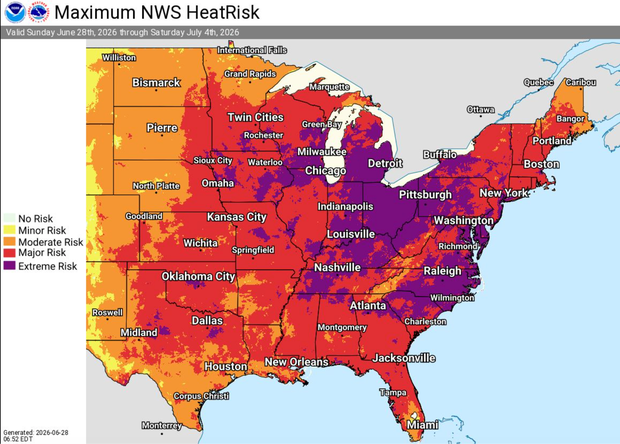
A significant heat wave is set to affect a large portion of the United States this week. According to the National Weather Service, high temperatures will precede the July Fourth holiday and will feel hotter due to accompanying high humidity levels.
Regions like the lower Great Lakes, the mid-Atlantic, and the Mississippi and Ohio River valleys will experience several days of intense heat. Major cities, including those hosting World Cup matches, may report their highest temperatures of the year.
Cities expected to be affected include New York, Philadelphia, Washington, Baltimore, Chicago, St. Louis, Detroit, Dallas, Little Rock, and Memphis. The heat will persist into next weekend across various areas like the Great Plains, Southeast, and mid-Atlantic.
This is the first widespread heat wave of the summer, impacting over half of the United States. The heat wave is expanding across the central and eastern regions, with the Four Corners area continuing to experience dangerous fire weather conditions. Meanwhile, severe thunderstorms are present in the northern Plains and Upper Midwest, stretching flooding concerns from the Rockies to the mid-Atlantic.
Temperatures will soar into the 90s and low 100s Fahrenheit (mid to high 30s Celsius). Combined with high humidity, heat indices will range from 100 to 110 degrees F (40 C to 43 C), and can rise as high as 115 F (46 C). Night temperatures in the 70s F (21 to 26 C) will offer little respite.
The National Weather Service’s heat index map, released on June 28, 2026, shows dangerous heat expanding across the eastern two-thirds of the country. The heat index accounts for humidity and provides insight into the apparent temperature, indicating what might be hazardous for prolonged exposure or physical exertion. Regions like Phoenix, Las Vegas, central Texas, and much of the southwest are already facing temperatures around 100 F.
To cope with the extreme temperatures, limit outdoor activities, stay hydrated, and ensure access to air-conditioning or other cooling zones, the weather service advised. The Centers for Disease Control and Prevention (CDC) states that heat can affect anyone, highlighting symptoms of overheating such as muscle cramps, dizziness, excessive sweating, breathlessness, headaches, weakness, and nausea.
While parts of the U.S. battle high temperatures, several western regions remain notably cooler. The Northwest and northern Rockies are experiencing temperatures 20-35 degrees below normal.
In Europe, high temperatures have been reported, with a record 106 degrees Fahrenheit in Germany. Switzerland, the Czech Republic, Denmark, and France have also been experiencing substantial warmth. In France, numerous drowning incidents have occurred this month as swimmers sought relief from the heat.