
Illinois has faced a surge in tornado activity according to weather officials, experiencing 147 tornadoes so far this year. This marks the highest on record, well above the state’s average of 54 tornadoes annually between 1990 and 2020. Previously, the most tornadoes recorded in a year was 142 in 2024. As of mid-2026, Illinois has exceeded this number substantially.
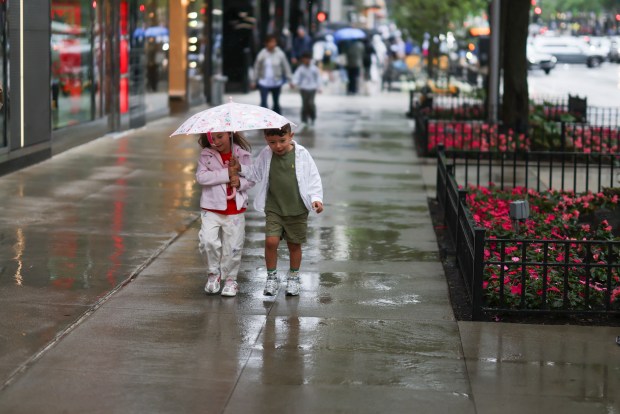
Data from the National Oceanic and Atmospheric Administration (NOAA) reveals that the state has surpassed historic figures, with only 91 tornadoes recorded by June 22 in a busy 2024. This year continues to break records with substantial tornado activity compared to previous years. Friends Deana Georgieva and Alex Kriltchev were spotted navigating a rainy Michigan Avenue on June 21, 2026.
Illinois has seen a consistent uptick in tornado instances, recording 121 in 2023, followed by 142 in 2024, and 126 in 2025. Until recent years, triple-digit tornado tallies were rare, occurring only during four years prior to this stretch, with the last instance in 2006.
Trent Ford, the Illinois State Climatologist, describes this as a significant shift rather than a mere trend. Data from the NOAA’s Storm Prediction Center indicates Illinois leads the national rankings, surpassing traditional Tornado Alley states such as Iowa, Kansas, and Texas.
Recently, Illinois braced for more severe weather. Northern areas experienced steady rainfall and localized flooding. While drier conditions are expected soon, Lake Michigan poses risks with life-threatening currents and sizable waves.
Lee Carlaw, a senior meteorologist at the National Weather Service Chicago office, notes an active start to the tornado season. A March outbreak led to a hyperactive period in April and June. Nevertheless, no severe weather is anticipated with upcoming showers.
The weather service office in Lincoln issued a tornado watch for areas of east central and southeast Illinois. Tornado warnings followed for Shelby County and Effingham County, highlighting risks with severe thunderstorms.
Confirmed tornadoes include an EF-2 in Charleston and Mattoon, and an EF-3 in Effingham. An EF-0 touched down in Pawnee Junction. Tornadoes are classified based on wind speeds, from moderate EF-1 to severe EF-3. The Effingham tornado caused significant damage, including property destruction and snapped trees.
Four more tornadoes rated EF-1 were confirmed in Springfield, Blue Mound, Bethany, and Grove Township. In Blue Mound, a tornado damaged an elementary school and local homes, emphasizing the severity of storms.
An EF-0 tornado was registered near Grayslake, impacting a local subdivision. Despite lower wind speeds, EF-0 tornadoes can inflict substantial property damage.
Illinois’s soaring tornado count in recent years is perplexing to experts. Even Iowa, a historically active tornado region, has lower figures this year. Despite limitations in satisfying explanations, factors like climate change contribute.
Human activities are releasing more humidity into the atmosphere, facilitating intense thunderstorms. Tornado frequency in the Midwest is increasing, supported by advanced reporting technologies. Tornado occurrences are also shifting to nontraditional months, extending the season of activity.
However, climate change alone doesn’t fully explain the sudden surge in tornadoes across four years. Ford highlights how particular weather patterns contributed to large outbreaks during atypical months.
La Niña and El Niño climate patterns affect severe weather conditions. La Niña has fostered active spring seasons recently, while El Niño might bring different conditions next year.