
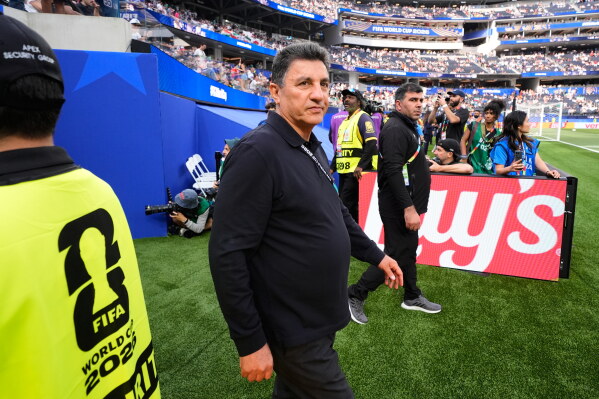
Iran’s head coach, Amir Ghalenoei, expressed concern over the treatment his team is receiving at the World Cup hosted by the U.S., citing travel restrictions and visa refusals. Despite these issues, Ghalenoei remains hopeful that FIFA will encourage the U.S. to ease these measures soon.
“I take pride in the support of the Iranian nation,” said Ghalenoei. “We play for our martyrs in Iran, but this treatment is damaging. Spending billions could not bring justice to our people. It underscores our country’s oppression. I hope for peace and that such behavior doesn’t become ingrained in the World Cup.”
Iran’s head coach Amir Ghalenoei walks on the field before the World Cup Group G soccer match between Iran and New Zealand in Inglewood, Calif., near Los Angeles.
Iran arrived in Los Angeles for their second match against Belgium, but Ghalenoei was forced to reduce the team’s training due to denied travel requests. “We needed a full day in Los Angeles, but got less than 16 hours,” Ghalenoei noted. “This limitation has made our preparation tough.”
Ghalenoei called on other World Cup teams and coaches to stand against the treatment faced by the Iranian team. “None of the 47 other coaches responded to me,” he said. “We are here for football, and our grievances stem from unfair treatment, not politics.”
The Iranian team operates under U.S. travel restrictions due to a conflict initiated on February 28. Team Melli must fly to their matches in the U.S. the day before the game and return immediately afterward to their base in Tijuana, Mexico. This schedule is standard for many teams, but Ghalenoei prefers more flexibility.
Iran midfielder Saeid Ezatolahi noted, “Our situation differs from other teams. While others focus on planning, we spend much time commuting.”
Ghalenoei praised FIFA President Gianni Infantino’s efforts to ease restrictions. He is optimistic that the U.S. will allow travel adjustments for the upcoming match in Seattle against Egypt, unlike previous restrictions.
During negotiations, FIFA tried to convince the U.S. government for earlier travel, but it was unsuccessful.
Iranian players listen to head coach Amir Ghalenoei during a training session ahead of their World Cup match against Belgium in Carson, Calif.
“The inability to adjust travel plans affects us mentally,” said Ghalenoei. “I appreciate FIFA’s attempts, though they haven’t yielded success.”
Iran’s first match against New Zealand ended in a draw after delays and issues during their trip. Despite improving customs delays in recent travel, Ghalenoei criticized the visa denials for essential support staff, again urging a more suitable approach for the World Cup.
Belgium’s right back, Thomas Meunier, empathized with Iran’s challenges, drawing parallels to facing Ukraine amid its conflict. “It’s challenging to separate football from politics,” Meunier said. “Iran’s situation should galvanize the team to excel. Such circumstances elevate motivation, driving them to make their nation proud.”