
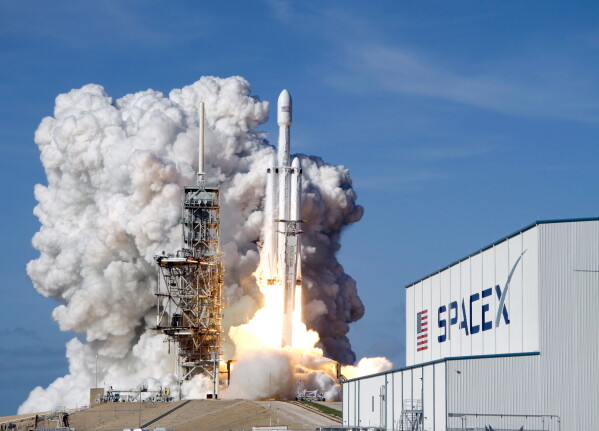
Elon Musk made history as the world’s first trillionaire following the landmark initial public offering (IPO) of his space exploration company, SpaceX. On Friday, SpaceX’s shares surged by 24% after they commenced trading, a strong indication that investors are optimistic about the company’s future financial prospects despite its current significant losses.
SpaceX shares began at $150 and quickly rose to around $168 by 2:20 p.m. ET. This rapid increase in share value resulted in an impressive market capitalization of $2.2 trillion for SpaceX. According to Forbes, Musk’s personal wealth is now estimated at $1.2 trillion, largely due to his substantial ownership in SpaceX and his role as the CEO of Tesla.
Motivation Behind SpaceX’s Public Debut
Founded in 2002, SpaceX has ventured into the stock market to raise funds for its ambitious projects. Musk has expressed his vision of deploying satellites, creating data centers in orbit, and establishing a human colony on Mars. He marked the IPO by participating in the Nasdaq’s ceremonial bell-ringing from SpaceX’s base in South Texas, sharing his goals to make human life multiplanetary.
“Not just a few astronauts, but whoever you are watching this,” Musk remarked, emphasizing that SpaceX aims to offer lunar and Martian travel to the general public.
Despite heavy annual financial losses, Musk generated significant interest for SpaceX’s IPO. Investors enthusiastically acquired shares priced at $135 before the actual trading began. SpaceX successfully raised $75 billion, surpassing the past record set by Saudi Aramco’s IPO in 2019. The company trades under the symbol “SPCX.” Elon Musk’s groundbreaking vision includes potentially housing a million people on Mars, saving humanity with additional space outposts, and launching massive orbiting data centers. To fulfill these ambitions, SpaceX needs substantial capital beyond what its current rocket and satellite operations generate.
Investor Opinions
While the Wall Street bankers involved in the IPO express enthusiasm, some experts caution that the stock’s valuation is overly optimistic. Analysts at Morningstar, who do not partake in investment banking fees, suggest the IPO is “significantly overvalued,” highlighting SpaceX’s untested technology and immense capital requirements. Their estimate values the company at $780 billion, less than half the IPO’s appraisal.
SpaceX has acknowledged in filings that several business objectives rely on “unproven technologies.” Additionally, the company’s artificial intelligence venture, xAI, is yet to find a viable profit route and is incurring significant expenses to match competitors.
During a livelystreamed meeting with JPMorgan Chase’s CEO, one of the major industries who benefited financially from the IPO, Musk provided limited details. He captivated the audience with tales of “moon hotels,” Martian settlements, and solar-powered data centers orbiting Earth. Yet, he shared scant information about his flagship chatbot Grok, opting instead to discuss satellites.
The Rise of Elon Musk’s Wealth
Elon Musk’s rise to trillionaire status stems from his successes in creating groundbreaking companies. He initially earned around $200 million from the sales of Zip2 and PayPal. Musk then used his earnings to establish SpaceX and invest in Tesla, both proving skeptics wrong by thriving in their respective industries. Much of his current wealth lies in stocks or grants contingent on reaching challenging targets. His most recent remuneration package from Tesla was met with criticism from the Vatican, illustrating its massive scale and impact.
Musk’s ventures, especially Tesla, have shown extraordinary growth since its 2010 IPO, delivering a return of 20,000% to investors, equating to over $1.2 trillion in investment wealth. SpaceX’s entry into the public market leads an anticipated trend with other major IPOs, including Anthropic and OpenAI. The Nasdaq revised its criteria to allow SpaceX quicker entry into index fund-linked investments, meaning investors could purchase shares earlier than expected.
Not all investors view SpaceX’s inclusion positively. Representatives from pension funds in California and New York, including those for firefighters and teachers, voiced concerns over IPO provisions like mandatory arbitration for shareholder claims and Musk’s control over the company.