
School districts across the country are dealing with falling student numbers, budget cuts, and financial shortfalls. This has intensified discussions about school closures and restructuring. Leaders face the challenge of minimizing costs while enhancing student academic recovery. However, one crucial aspect is often ignored: the unequal impact of school closures.
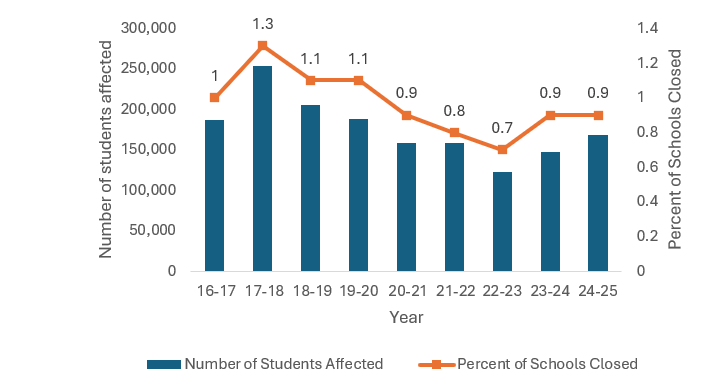
Research indicates that school closures disproportionately affect Black students and those from low-income backgrounds, groups already facing significant educational hurdles post-pandemic. Each year, about 1% of public schools shut down, displacing approximately 100,000 to 250,000 students. This is like uprooting an entire large school district annually.
The COVID-19 pandemic slowed the rate of permanent school closures initially, but as relief funds dwindled, closure rates approached pre-pandemic levels. In 2017-2018, the closure rate was at 1.3%, dropping to 0.7% in 2022-2023, but it increased to 0.9% in the subsequent years, indicating resurging pressures.
Uneven Impact and Closure Patterns
School closures affect Black and low-income communities the most. Research shows that schools with predominantly Black and high-poverty student populations are often first in line for closure. In 2024-2025, schools with mostly Black students accounted for about a quarter of closures, despite representing less than 10% of all schools. High-poverty schools show similar overrepresentation.
These patterns persist even when student enrollment declines equally across different schools. Schools serving Black students are notably more likely to close. In cases where enrollment drops by 50%, high-poverty schools with all Black students face closure rates double those of schools without Black students. These closures disrupt student progress, with marginalized students suffering the largest setbacks and still needing extensive recovery time.
Stable environments are critical for sustaining improvements in schools with students of color, which have seen significant post-pandemic gains. School closures interrupt student relationships and learning structures, potentially reversing progress.
Disruptive Effects on Learning and Communities
Closures lead to short-term academic and behavioral setbacks, especially if students move to lower-quality schools. Studies in cities like Chicago and Philadelphia indicate that displaced students show performance dips in reading and math, unless they transfer to substantially better schools. Moreover, moving affects receiving schools, often dropping their performance, and necessitates longer commutes that increase absenteeism and suspension rates.
Systemic barriers like long travel, lack of transportation, and limited school seats restrict displaced students’ access to better educational opportunities. Consequently, the academic benefits of closures remain minimal.
Efficacy of School Closures for Cost Reduction
Financially, school closures don’t always bring the expected savings. National research reveals variable fiscal benefits from closures. Long-term studies in Texas associate closures with lower test scores, more disciplinary issues, reduced high school completion, decreased college participation, and lower adult employment and earnings. Negative effects are pronounced among students from low-performing or economically challenged schools.
For equitable outcomes, district leaders must address the biases in closure decisions, preventing harm to Black and low-income students. Closure strategies should minimize the impact on neighborhood schools that support these communities. If closures are unavoidable, they should be handled equitably, transparently, and with community input. This involves securing better school placements for displaced students and stabilizing receiving schools with reduced class sizes, transportation, and counseling support.
Policymakers must tackle the underlying causes driving closures, such as gentrification, cuts in state education funding, and broader social issues affecting school enrollments. District leaders shouldn’t face these structural challenges alone, as closures significantly alter children’s daily lives. The frequent burden placed on the same communities is unjust. State and district leaders can adopt alternative strategies to protect student progress, ensuring those owed the greatest educational support are not asked to sacrifice the most.