
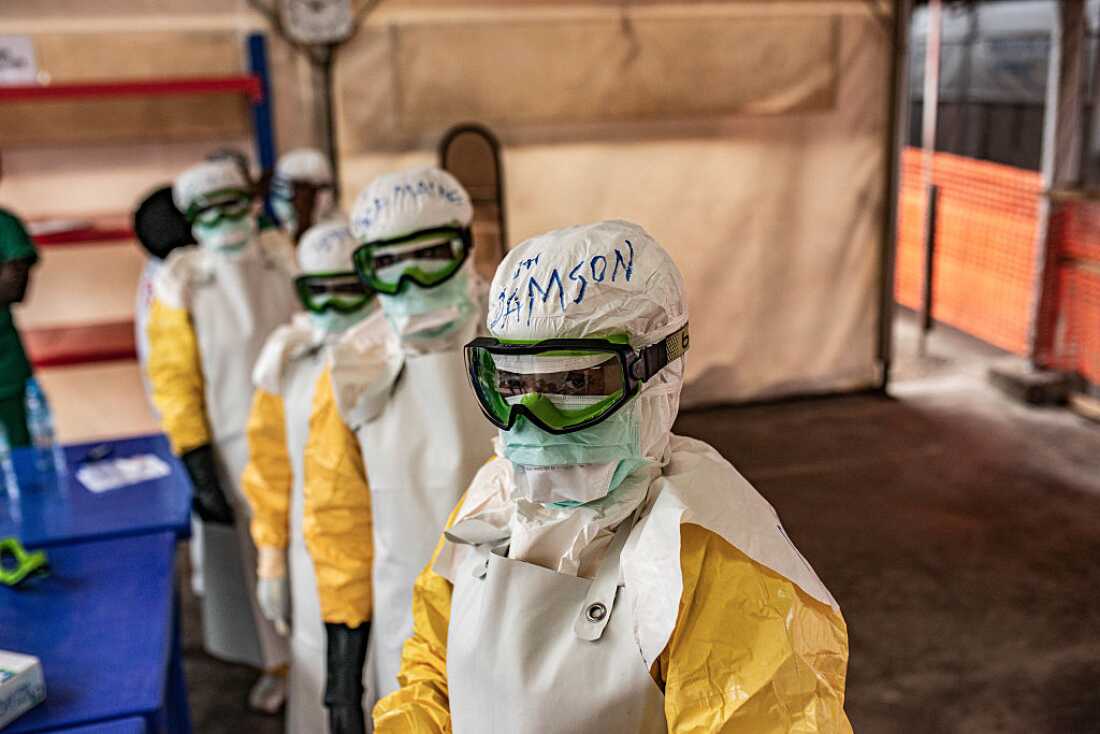
Health workers don protective equipment at an Ebola treatment center on June 2, 2026, in Monigi, Democratic Republic of Congo. The Ebola outbreak in Africa threatens to reach levels similar to the outbreak in West Africa a decade ago. Projections suggest 20,000 cases and over 4,000 deaths could occur within the next three months.
The U.S. Centers for Disease Control and Prevention (CDC) conducted analyses predicting the potential severity of the situation. Both the Democratic Republic of Congo and Uganda are working to manage the epidemic, which led the World Health Organization to declare an international health emergency.
CDC research highlights the necessity for large-scale, swift public health actions to limit the disease’s spread and avoid a worst-case scenario. Jason Asher from the CDC’s Center for Forecasting and Outbreak Analytics emphasized that if only 20% of cases reach isolation within two days of symptoms, more than 20,000 cases could arise in certain scenarios.
The current outbreak could become the deadliest recorded if it persists. During the 2014-2016 outbreak, West Africa experienced about 28,000 cases, marking the largest known outbreak. While the outlook seems grim, efforts on the ground are challenging due to active conflict and healthcare access issues.
Isolating infected individuals promptly after exposure is crucial to containing the outbreak. If international efforts raise isolation rates to 70% within two days, there is a 94% chance of keeping cases below 10,000 in the coming months, Asher noted.
Jennifer Nuzzo from Brown University School of Public Health stressed that the outbreak is on a concerning path and will worsen without increased efforts at the source. One of the CDC papers addressed U.S. risk, confirming it remains low. Ebola is dangerous but does not spread as easily as COVID-19 or the flu. The U.S. can identify and isolate cases efficiently.
Satish Pillai, CDC Ebola response incident manager, assured that domestic risk stays low for Americans. There’s no cause for behavioral changes or international travel concerns, except for trips to the Democratic Republic of Congo or Uganda.
Pillai asserted that it is not too late to act, emphasizing control, containment, and ending outbreaks in the DRC and Uganda as primary goals. He reiterated the feasibility of ending such outbreaks based on past experiences.
Anthony Banbury, a former U.N. official, cautioned in the Washington Post that the Ebola situation in Africa will worsen without a major shift in international response. He called for a coordinated global effort to combat the rising case numbers.