
Energy experts agree on the urgency for new power sources and are exploring technology and infrastructure to meet the rising demand. Exelon CEO Calvin Butler stated, “As an industry, we are investing approximately $1.1 trillion in our infrastructure over the next five years to ensure that we’re meeting that need and that demand.”
In 2024, data centers accounted for about 1.5% of global electricity consumption, and this demand is increasing. Data centers are expected to become the fifth-largest energy consumer globally, with usage levels between those of Japan and Russia.
Exelon’s Role in Power Distribution
Exelon, one of the largest electric utility companies in the U.S., operates the electric grid infrastructure that supplies power to homes and businesses. “We’re a pure transmission and distribution company,” Butler explained. “Our responsibility is to operate a safe, reliable, and resilient grid.” Recent data shows supply costs in the PJM region have surged by 645% since 2024.
GOP URGES SCOTUS TO REJECT ‘WAR ON AMERICAN ENERGY’ THAT THEY SAY WOULD HIT FAMILIES’ WALLETS
Fusion Energy as a Solution
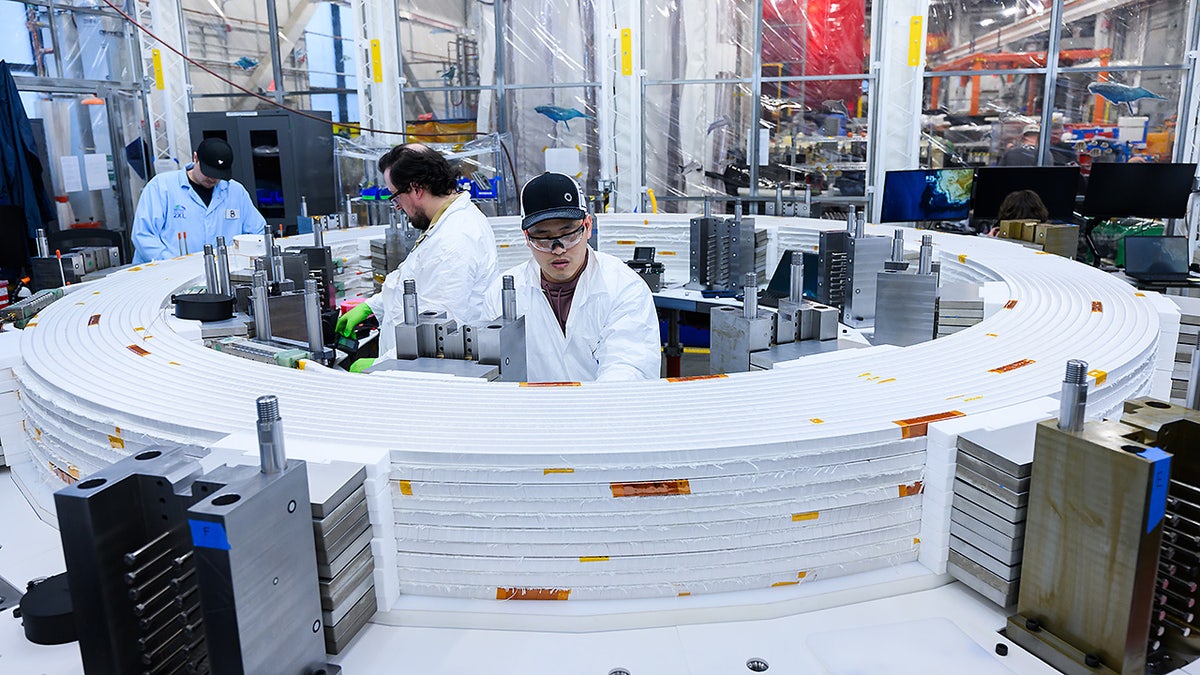
Innovation in energy production is crucial. Commonwealth Fusion Systems, based in Devens, Massachusetts, is developing fusion technology to provide new sources of carbon-free electricity. Fusion energy, similar to the processes fueling the sun and stars, is seen as a potential game-changer. “When you take light nuclei like hydrogen and combine them, you release energy,” said Brandon Sorbom, co-founder of Commonwealth Fusion Systems.
Studies show optimism in the scientific community regarding fusion for commercial use. Commonwealth Fusion Systems projects that its ARC fusion power plant could produce 50 times more power than it consumes, with each facility potentially powering a small city for a year. Backed by top universities and partnerships, these efforts aim to revolutionize the energy landscape.
However, uncertainties remain. MIT research suggests fusion might provide 10% to 50% of electricity by 2100, yet the process is expected to be costly.
THE REAL REASON YOUR ELECTRIC BILL IS SOARING THIS SUMMER WILL SURPRISE YOU
Integrating Fusion Systems
Sorbom discusses the challenges of fusion implementation. “Building this commercial system for the first time is complex,” he said, emphasizing the intricacy of coordinating components. Fusion’s integration demands precise execution to achieve the modeled outcomes.
Shift to Nordic Data Centers
Some companies opt to move data centers to regions requiring less power. The Nordic countries offer favorable conditions for such facilities. “The Nordics have abundant power—it’s green and cost-effective,” noted Philippe Sachs of Nscale. The cool climate benefits hardware cooling, reducing overall energy needs.
Nscale operates data centers in the Nordic region, providing AI services and Nvidia chip rentals. “We recognized the importance of power availability in the AI era,” Sachs said. “The Arctic Circle offers unmatched advantages.”
HOW THE WAR IN IRAN REALIGNED EUROPE’S ENERGY FUTURE AROUND AMERICA
Benefits of Nordic Locations
The Nordic region possesses extensive land and renewable energy resources. “Cold weather allows us to use server-generated heat for residential heating,” John Wernvik of EcoDataCenter remarked. This efficiency makes the region particularly attractive for data center operations.
Norway, for instance, with 50% of its land above the Arctic Circle, boasts some of Europe’s lowest energy costs. The isolation of northern regions from major population centers limits industrial competition for power.
Commonwealth Fusion Systems aims to establish a functional nuclear fusion reactor by the early 2030s. Current projections indicate the emergence of 134 existing data centers in the Nordics, with 71 more in development. “AI computing demands substantial energy,” Wernvik explained. “Efficient solutions are crucial for sustainability.”
Construction in this region faces challenges. “First-time builders in the Nordics often encounter delays,” Wernvik added. Adapting to the climate and seasonal changes adds complexity to construction projects.
Despite these difficulties, global efforts persist in addressing power demands. Sorbom emphasized, “There is a strong correlation between energy use and quality of life. Finding ways to produce more energy safely and cleanly is essential.”