
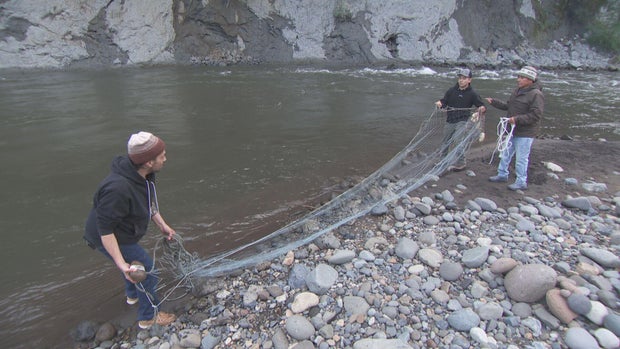
For the Muckleshoot tribe, salmon signifies more than sustenance. It embodies a legacy of culture and tradition that members strive to preserve. Descended from the Duwamish and Upper Puyallup peoples, this tribe has historical roots in the Seattle area stretching back thousands of years, earning them the name ‘Salmon People.’
Mike Jerry Jr., a 21-year-old tribe member, reflects on this connection. “We have a bond with the fish and the water, and you can feel it within you after fishing or swimming,” he shares.
Passing On Traditions
Michael Jerry Sr. and his brother Cory are committed to passing down traditional fishing practices to Jerry Jr. Early one morning, they taught him how to cast a small net to catch spring salmon. The aim is to catch a single salmon each time.
“It’s a process,” says Cory Jerry. “From processing to preservation, drying, and smoking, this tradition has been part of my upbringing. This is something we want to continue passing down.” This practice ensures that younger generations stay connected to their heritage.
Jerry Sr. began fishing this way when he was young and emphasizes its importance for his son. “The experiences, stories, and memories I have are passed to the next generation,” Jerry Sr. states. “This is crucial for my son and all our people.”
Spiritual Bonds with Salmon
For the Muckleshoot, fishing holds deep spiritual meaning. “The salmon are our relatives,” says Muckleshoot oral historian Warren King George. “They visit us annually, and maintaining this bond is vital.”
This relationship is epitomized in the legend of Salmon Boy, an ancestor who vowed to care for the fish’s ecosystem. The salmon, in return, promised to return each year to sustain the community. This promise is honored with the annual First Salmon Ceremony, celebrating the season’s first salmon.
“We gather and feast to thank our relative for returning home to nourish us,” King George explains.
The Struggle for Fishing Rights
Access to fish has not always been straightforward for Native American tribes in the Pacific Northwest. History notes the first tribal member cited for fishing outside reservation lands in 1892. The man, Big John, was fined and prohibited from traditional fishing activities.
“We were limited to fishing and gathering only on reservations,” King George recounts. This conflict spurred the ‘Fish Wars’ of the 1960s, marked by protests for fishing rights beyond reservation lines.
“Salmon rights encompass all natural resources,” says King George, highlighting the broader implications of their protests. These efforts led to the 1974 Boldt Decision, which granted tribes half the harvestable salmon.
Current Challenges and Conservation Efforts
Today, Muckleshoot fishers contribute 2% of the global wild salmon catch. Phil Hamilton of the Muckleshoot Fish Commission emphasizes sustaining salmon populations to continue their economic value.
“The salmon have sustained our way of life for generations,” Hamilton asserts. “Now, we must sustain them.” Environmental factors remain the largest threat to salmon populations, prompting the tribe’s long-term investment in habitat protection.
Hamilton notes, “We’re losing 5% of the habitat annually, so it’s crucial to protect what remains.” Ensuring clean water is essential. “Without water, there are no fish,” he reminds. “We’ve secured key settlements to ensure water availability for salmon.”
Conservation efforts have aided salmon population recovery since declines in the 1990s. The community, once down to a handful of fishing boats, now supports more than 200 boats for 500 fishers.
“Seeing the joy of our fishers makes all efforts worthwhile,” Hamilton shares.