
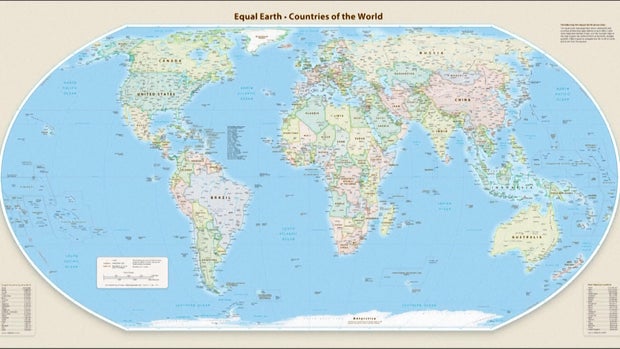
The United Nations General Assembly has endorsed a more accurate world map that highlights Africa’s larger true size. This decision follows a campaign led by African nations and advocates. The resolution passed with 164 member states in favor, sponsored by Togo and supported by the African Union. The United States voted against it, while six countries including Serbia and Ukraine abstained.
The vote encourages global governments and institutions to switch from the traditional Mercator map to the Equal Earth projection. Advocates and geographers assert that the Equal Earth projection represents locations more accurately. Unlike the Mercator projection, which makes Greenland appear similar in size to Africa, the new projection shows Africa is 14 times larger than Greenland.
It should be noted that the resolution does not ban the Mercator map, but encourages the use of the Equal Earth map. Togo’s Foreign Minister, Robert Dussey, emphasized the influence of maps in shaping worldviews: “Maps guide education, nourish the imagination, and influence collective perceptions.”
Africa No Filter, a leading campaigner, praised the resolution and expressed their desire for accurate maps in educational materials, media, businesses, and digital platforms. Countries worldwide have supported this change. French Foreign Minister Jean-Noël Barrot remarked, “Changing the map does not change the world, but correcting a distorted representation is an act of truth.”
The Mercator map, created in the 16th century by Flemish cartographer Gerardus Mercator, served navigational purposes but distorted land sizes. It enlarged polar regions like North America and Greenland, while reducing the sizes of Africa and South America. The 2018 Equal Earth projection, based on the Earth’s curvature, presents continents in their actual proportions.
Geographers argue the traditional map’s relevance is limited to navigation. Syracuse University geography professor, Mark Monmonier, states, “Outside of that very narrow navigation application, there is no point in using it.”