
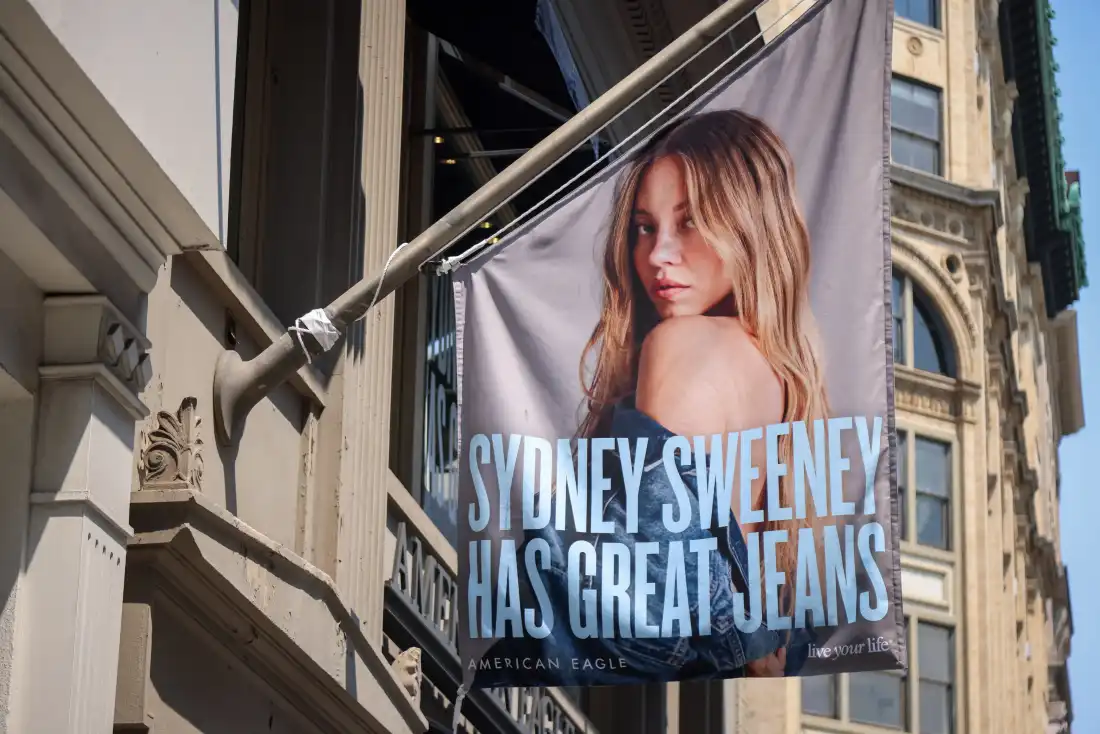
An advertisement featuring actress Sydney Sweeney outside an American Eagle store in New York sparked controversy. The tagline, “Sydney Sweeney has great jeans,” led to debates. Critics questioned if it was a nod to eugenics, given Sweeney’s appearance. However, the focus shifted to the garment workers behind the jeans.
Life in Garment Factories
In Karachi, Pakistan, a garment worker watched the ad on a smartphone. Her recognition was for the denim, not Sweeney. Known as ‘S.’ for privacy, she identifies the jeans she’s worked on in American Eagle production lines. Employed by Artistic Garment Industries, S. earns about $144 monthly. Her earnings support her son and mother.
S. describes oppressive conditions, working in extreme heat with limited water breaks due to production targets. She checks the quality of 1,000 to 1,600 clothing items daily and has fainted thrice in the year due to these conditions. Artistic Garment Industries states it has a robust complaint system and does not pressure workers.
Garment Workers’ Voices
Interviews with around 20 workers in factories in Pakistan and Bangladesh reveal common issues: low wages, high production targets, and sweltering factory environments. Workers handle products for brands like Levi’s, The Gap, H&M, and American Eagle.
Jason Judd from the Global Labor Institute highlights the heating issues. High temperatures inside factories result from machinery and ventilation problems, exacerbating heat stress among workers. Cara Schulte of Climate Rights International notes that while brands demand fast production, workers face health risks from extreme heat.
Struggles of Fast Fashion
In Dhaka, Bangladesh, worker ‘R.’ describes working six days a week, 12 hours daily, for $140 a month. Her factory lacks air conditioning, and despite reaching 98°F this summer, R. avoids drinking water to minimize bathroom breaks. She fears job loss and harassment for missing targets.
Despite challenges, some workers consider certain factories better. R. experiences higher pay, and if terminated, she receives her owed wages. Yet, issues persist with demands exceeding humane conditions.
Efforts for Worker Protection
A legally binding International Accord exists in Bangladesh for worker safety post the Rana Plaza collapse in 2013. Approximately 248 brands have signed, affecting nearly 2.8 million workers. Pakistan followed in 2023, though with more limited scope. A protocol on heat stress is being developed to ensure better working conditions.
Many workers in Karachi, employed by Artistic Garment Industries and Artistic Milliners, report health problems from heat exposure. Short breaks are allowed in extreme cases, yet job security fears prevent workers from taking them.
Fashion Industry Response
Brands such as Levi’s, The Gap, and H&M acknowledge the workers’ issues and claim to work towards fair labor practices. They perform audits to check compliance, yet workers report being prepped to depict favorable working conditions during these checks.
In other words,” I says, “they ask us to lie about everything.
The article, with input from NPR reporters, emphasizes the need for transparency and accountability in the global garment industry.