
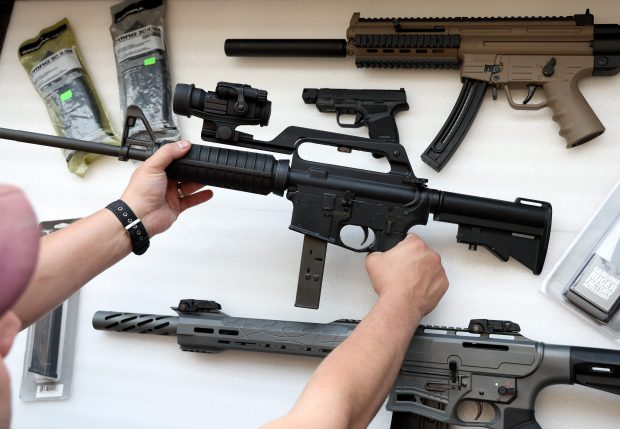
The U.S. Supreme Court has announced it will hear arguments regarding Cook County’s ban on assault weapons, along with a similar law in Connecticut. This decision could lead to a pivotal ruling on the constitutional right to own such firearms.
Background on the Case
The Cook County case arises from a lawsuit filed by three residents and two gun rights organizations. They argue that the county’s ban on assault weapons, including the AR-15 and similar semi-automatic rifles, violates the Second and Fourteenth Amendments. Cook County State’s Attorney Eileen O’Neill Burke has pledged to defend the ordinance, asserting that assault weapons are inappropriate for community safety.
The ordinance covers over 100 types of firearms, including rifles, shotguns, and pistols. It prohibits the sale, manufacture, transfer, acquisition, or possession of these weapons, as well as large-capacity ammunition magazines that hold more than 10 rounds. Although exceptions exist for law enforcement and the armed forces, violators face fines and potential jail time.
Related Legal Challenges in Illinois
Separate from the Cook County case, there is a lawsuit challenging Illinois’ statewide ban on assault weapons and high-capacity magazines. This state law, effective since January 2023, was enacted following the tragic mass shooting at a Highland Park parade. Although the law has survived legal challenges, some view the state’s restrictions as unconstitutional.
U.S. Supreme Court Justice Clarence Thomas previously expressed doubts about the constitutionality of Illinois’ law, citing concerns over its broad nature in restricting common semi-automatic firearms.
Potential Ramifications
A Supreme Court decision favorable to the Cook County plaintiffs could significantly impact the Illinois case. David Sigale, an attorney for an Illinois gun rights group, believes a favorable ruling could reshape the state’s legal landscape regarding firearm regulations.
Illinois’ Attorney General has defended the state’s ban by arguing that the weapons in question are not protected under the Second Amendment, as they possess traits similar to military arms not typically used for self-defense.
Impact on Broader Gun Legislation
Similar laws exist in several other states, including New York, Los Angeles, and Washington, D.C. The expiration of a national assault weapons ban in 2004 has led some Democrats to advocate for its revival in response to mass shootings.
Connecticut’s law was enacted after a gunman used an AR-15 in the Sandy Hook Elementary School tragedy. These laws target firearms deemed preferred by mass shooters and align with military-grade weapons.
Assault Weapons and the Second Amendment
Gun rights advocates argue that banning semi-automatic rifles violates constitutional rights, highlighting their widespread ownership in America. Adam Kraut from the Second Amendment Foundation has expressed the need for Supreme Court direction on this issue, noting the broad ownership of such firearms.
Key Factors and Precedents
The Cook County plaintiffs cite the Supreme Court’s 2022 decision in New York State Rifle & Pistol Association v. Bruen, which expanded Second Amendment rights. They assert that laws must align with historical traditions to remain valid, pointing to the common usage of banned weapons as protected under these traditions.
In early rulings, including a 2024 decision by U.S. District Judge Rebecca Pallmeyer, Cook County’s ban was upheld. However, the plaintiffs continue their appeal, emphasizing landmark Second Amendment decisions.
As the Supreme Court prepares to hear the Cook County and Connecticut cases, the anticipation grows over potential shifts in the legal interpretation of gun rights and regulations at both state and national levels.