
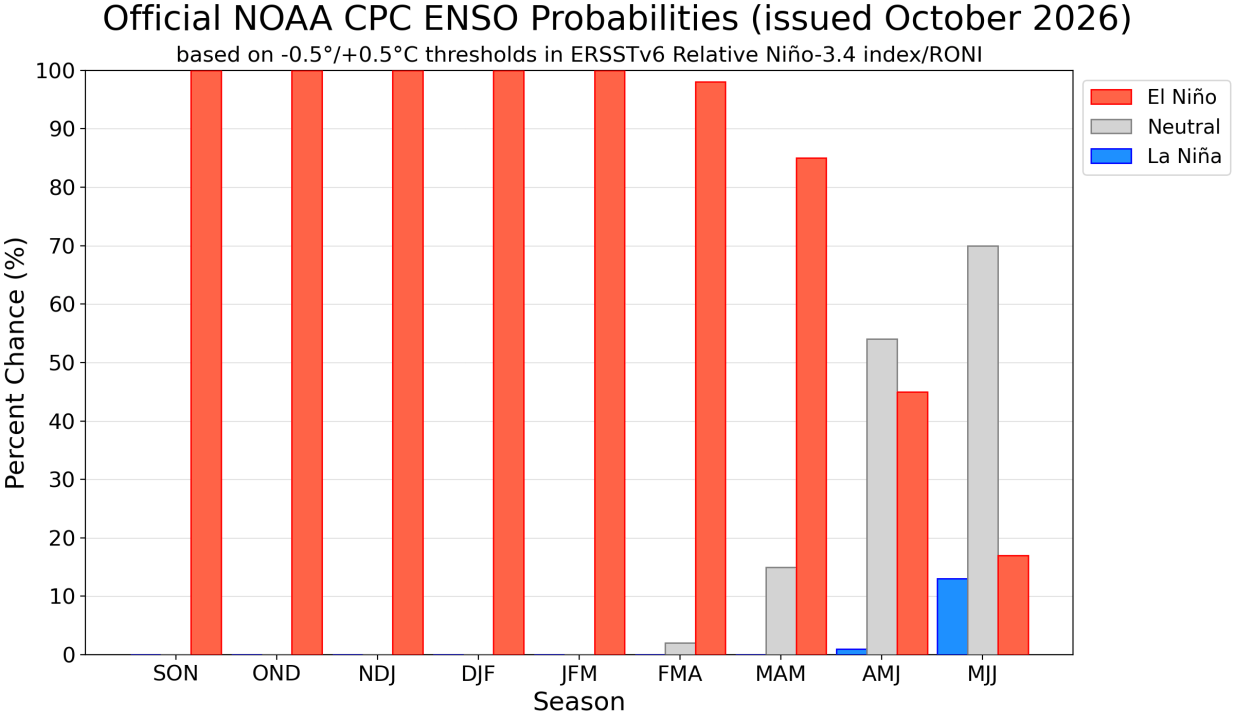
The ongoing El Niño event has been recognized as potentially the strongest in recorded history, with recent forecasts indicating further intensification. The NOAA’s Climate Prediction Center recently communicated that El Niño has strengthened over the past month, and anticipates a period of strong-to-very strong El Niño conditions from January through March. Various forecasting models predict continued strengthening of El Niño until at least the end of the year, with a significant likelihood of surpassing historical El Niño events since 1950.
Azhar Ehsan, a climate scientist from Columbia University, presented data last month confirming that the probability of El Niño persisting through spring is essentially guaranteed, ranging from 99% to 100%. The NOAA’s Climate Prediction Center corroborates this stance, projecting El Niño’s presence for the forthcoming six months, followed potentially by a shift towards a La Niña pattern.
The Global Seasonal Climate Update from the World Meteorological Organization highlights that El Niño is expected to reach its apex in December, with sea-surface temperatures likely to rise to unprecedented levels. This phenomenon doesn’t introduce new heat to the planet, but instead releases heat stored beneath the ocean surface, contributing to hotter year measurements, including projections for 2024.
Nexstar’s chief meteorologist Brian James emphasized the substantial impacts of this enduring El Niño on forthcoming weather conditions, expecting divergent weather experiences across the northern and southern United States. While northern states may anticipate drier and warmer conditions, the southern regions could face cooler and wetter weather.
Daniel Swain, a climate scientist at the California Institute for Water Resources, expressed significant concern over the magnitude of this El Niño event, especially within our rapidly warming climate. California has already declared a state of emergency, addressing expected impacts from this severe pattern, similar to the historically impactful El Niño of 1997. That period experienced significant temperature and precipitation extremes, marking one of the country’s second-warmest and seventh-wettest winters since records began in 1895. Current temperature and precipitation outlooks align closely with typical El Niño patterns.