
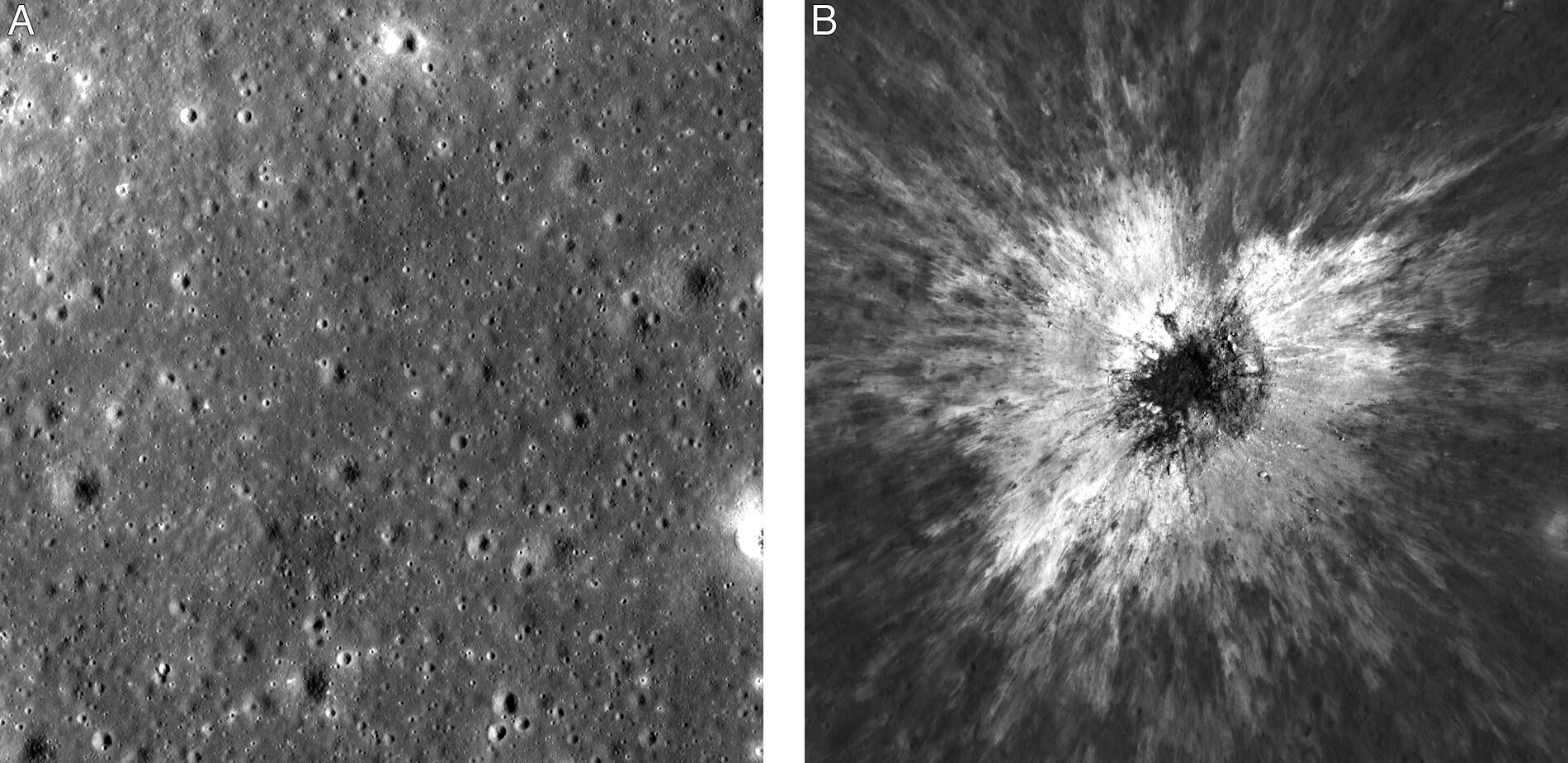
Scientists have detected a new lunar crater that surpasses the size of the Roman Colosseum. It formed from a significant impact two years ago that initially went unnoticed. The crater, found by NASA, spans approximately 728 feet in diameter and reaches depths of 141 feet, equivalent to three stacked yellow school buses.
This recent discovery marks the largest known impact crater in the solar system created recently. Researchers estimate that such large-scale events occur once every 132 years, making the crater a valuable source of information. NASA plans to use this data as it develops an astronaut base on the moon.
The scientists noted, “This event constitutes a statistically rare, effectively once-in-a-lifetime observation.” This statement appears in one of the studies published in the journal Science Advances.
NASA’s Lunar Reconnaissance Orbiter (LRO) identified the crater on the moon’s near side between April 11 and May 22, 2024. The crater resulted from a fragment of an asteroid or comet, sized akin to a three to six-story building, hitting the lunar surface. Earth and space-based telescopes missed the real-time observation. The data was processed in August 2025, and LRO gathered detailed imagery in the following fall, confirming the discovery early this year.
This new crater, named after Thomas McGetchin, a former director of Houston’s Lunar and Planetary Institute, is three times larger than a previous record-holder found by the LRO a decade back. The moon, with a history of ancient impacts, includes craters over 1,500 miles wide. The latest impact altered the surface over 66 miles, dispersing dust and soil unexpectedly, according to Mark Robinson, chief scientist for LRO’s cameras at Intuitive Machines.
Robinson, lead author of one of the studies, described a 4-mile cold spot around the crater, suggesting the topsoil loosening. David Paige from UCLA co-authored the study, comparing the loosening to gardening. “We’re now thinking of impacts as a way to garden the regolith — churning the sediments and bringing underlying materials to the surface,” Paige explained.
Since 2009, NASA’s Lunar Reconnaissance Orbiter has surveyed the moon, preparing to send astronauts back. LRO’s findings indicate that lunar soil overturns every 80,000 years, challenging the idea that Apollo moonwalkers’ footprints would remain forever. Robinson stated, “They will definitely be long gone in that time frame.”
The subsequent task is evaluating risks associated with ejected crater material impacting NASA’s proposed moon base. Robinson concluded, “That information will help engineers harden structures to mitigate damage concerns.”