
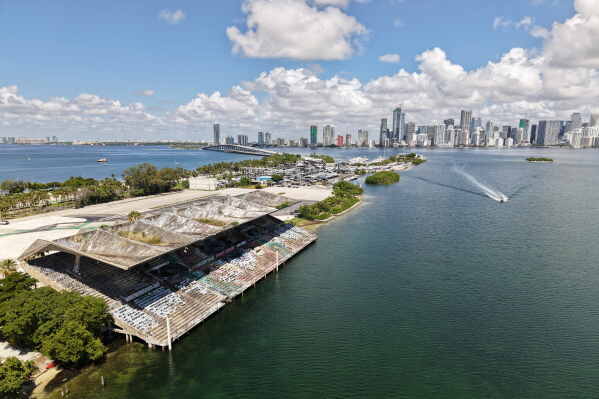
The Miami Marine Stadium stands as a significant piece of midcentury Brutalist architecture. Known for its grand cantilevered roof and captivating view of the city, it originally opened in 1963 as the nation’s first powerboat race venue. This venue, a South Florida icon, was designed by Hilario Candela, a Cuban refugee.
The stadium gained fame as the backdrop for Elvis Presley’s 1967 film “Clambake.” Performers like Gloria Estefan and the late Jimmy Buffett graced its movable, floating stage. However, after sustaining considerable damage during Hurricane Andrew in 1992, the 6,500-seat venue fell into neglect. Today, despite being on the U.S. National Register of Historic Places, it remains fenced off and covered in graffiti.
On Tuesday, voters will decide if the city should collaborate with a private firm to restore the stadium, which sits on Virginia Key, facing downtown Miami. The stadium’s historical significance is evident in past events like the 1972 campaign rally with President Richard Nixon and Sammy Davis Jr., along with various community gatherings. Miami Commissioner Damian Pardo emphasizes the stadium’s deep connection with the Miami community.
It encapsulated a time period in Miami that’s incredibly unique with an incredible story that touches all Miamians.
Architect Hilario Candela designed the structure in his late 20s, contributing to architectural projects across Miami. Until his death in 2022, he led efforts to restore the marine stadium. The National Park Service included it in the National Register of Historic Places in 2018, highlighting its architectural and historical value.
Buffett, a staunch supporter, advocated for the stadium’s revival. He fondly recalled a 1985 concert, marking it as one of the most enjoyable for both him and his fans.
Restore Miami Marine Stadium, co-founded by Donald Worth, began its mission in 2008 to save the venue. Worth cites both the architecture and history as core elements of its appeal.
Deciding the Stadium’s Fate
Breakwater Hospitality Group, led by Emi Guerra, suggests that the view and location of the stadium make it a potential entertainment hotspot. He compares it to Denver’s Red Rocks Amphitheatre.
Guerra acknowledges voter skepticism, but stresses that Miami retains ownership, with the management company executing the city’s vision.
When it’s something that’s historic, you have two options: restore it or let it rot.
Ernesto Cuesta of the Brickell Homeowners Association presents an alternative. He supports preserving the historic landmark but expresses concerns about noise and traffic. He suggests transforming the area into a park with green spaces.
Honoring the Past While Moving Forward
Despite decades of disuse, studies affirm the stadium’s structural integrity. Project architect Richard Heisenbottle, known for restoring Miami landmarks, emphasizes honoring the original architect. Renovations will incorporate modern amenities and accessibility improvements. The stadium’s original construction used galvanized steel rebar, preventing severe deterioration.
Commissioner Pardo notes that previous attempts to reopen the stadium were hampered by the city’s limited capacity to manage a major event space. A referendum will permit the city to enter a management agreement with a private company, responsible for developing a flex park from the stadium’s parking area. This project would provide public recreational spaces and an events area. Revenue from events will finance repairs and upgrades, with no tax burden on residents.
Pardo concludes, It’s the right time to finally do this.