
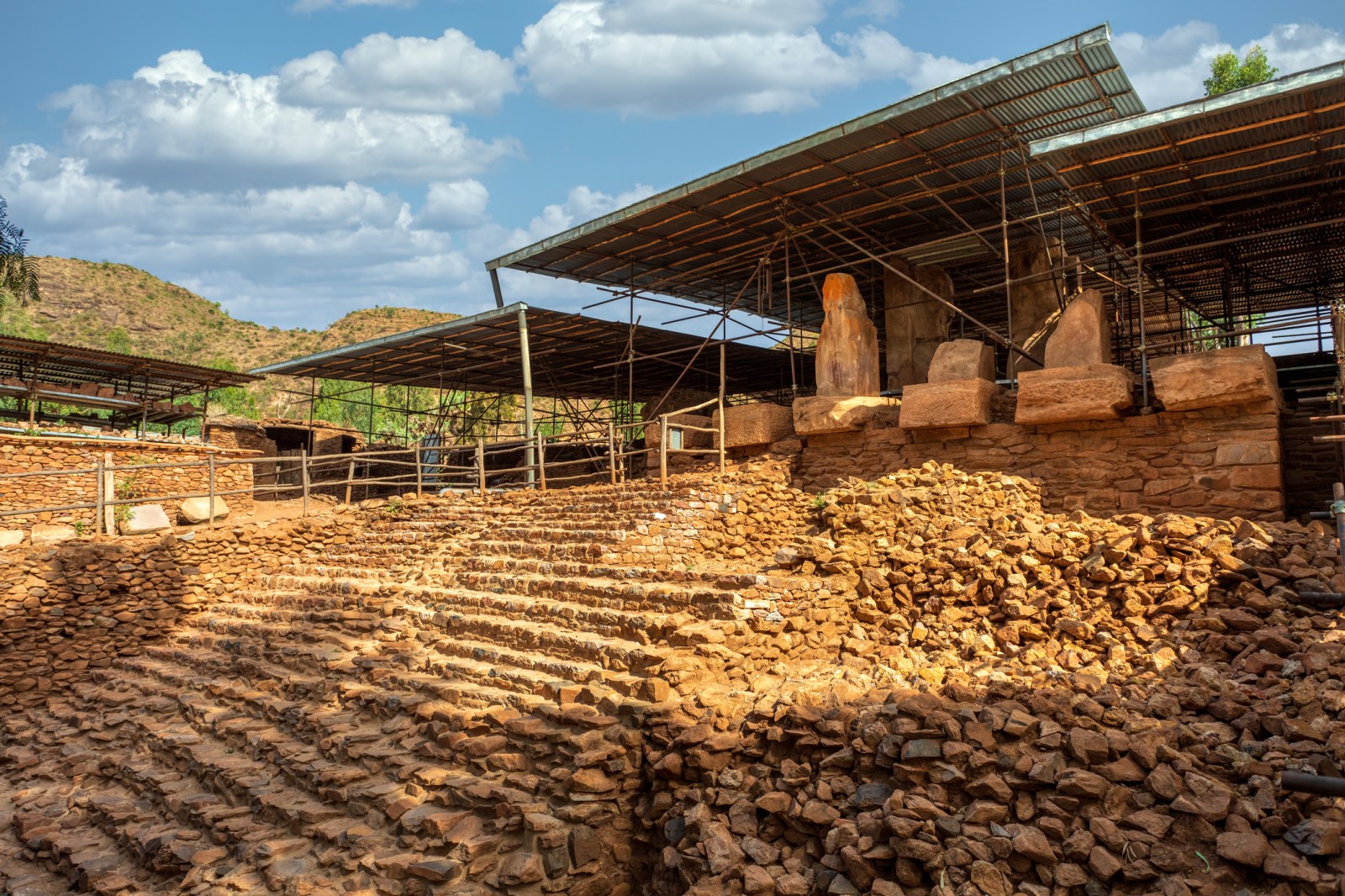
New discoveries at the Grat Be’al Gibri palace in Ethiopia provide insights into ancient engineering marvels. Spanning about 2,800 years, this palace from the Ethiopian-Eritrean highlands offers a fascinating glimpse into early construction techniques.
Significance of the Study
A team led by the German Archaeological Institute and Brandenburg University of Technology Cottbus-Senftenberg examined the site in detail. With a floor area of approximately 60 by 60 meters, the palace stands as a testament to its era’s architectural prowess in South Arabia and East Africa.
The Grat Be’al Gibri palace remains—partially due to a fire in antiquity. However, the surviving ground floor and podium reveal intricate construction methods involving rubble masonry and timber reinforcement.
Technological Insights
Using modern techniques, researchers created a virtual 3D model of the palace. This allowed them to assess the load-bearing capacity of its walls through the finite element method (FEM).
“The 3D simulations confirm that clay walls, timber, and stone were part of an established technology in Yeha,” historian Kwasi Konadu noted.
These analyses revealed a remarkable load-bearing capacity, suggesting that the palace’s structural system could have supported multiple levels.
Redefining Ancient Narratives
Previous accounts referenced multi-story structures without concrete evidence. The new findings provide quantitative proof of the palace’s advanced construction capabilities.
Professor Davide Tanasi commented that this validates the sophisticated nature of the system.
The research indicates a wall system theoretically capable of supporting up to 19 floors. However, this relates to load capacity rather than actual height.
Broader Implications
The study challenges previous assumptions, highlighting that advanced engineering was not confined to regions like Egypt and Rome.
“African builders expertly calculated height, material, and load millennia ago,” Konadu affirmed.
This work underscores the technological sophistication in the Ethio-Sabaean world, where diverse building traditions merged.
Lead researcher Martin Drieschner emphasized the potency of modern engineering methods in analyzing such ancient structures.