
By the end of 2026, NASA is collaborating with Boeing on the launch of an unpiloted Starliner capsule. This test flight is scheduled for the December-to-January timeframe, aiming to evaluate upgrades following a 2024 mission that experienced significant propulsion system failures. As a result, two astronauts remained stranded at the space station for over nine months.
Assuming the test flight is successful, NASA and Boeing intend to proceed with a piloted Starliner flight by mid-2028. The mission will integrate redesigned propulsion system valves, more durable subsystems, and additional modifications to avoid past failures. Veteran astronaut Warren “Woody” Hoburg will oversee the mission.
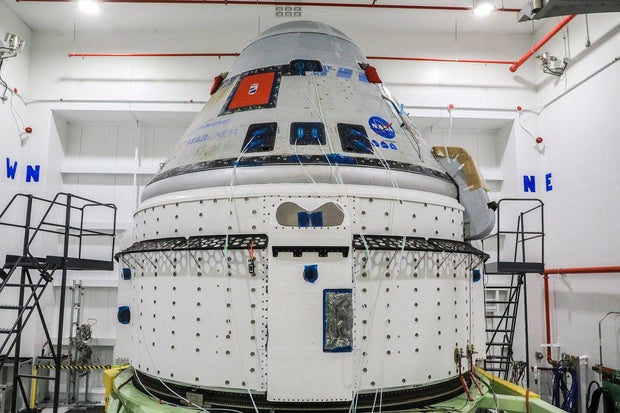
Currently, SpaceX’s Crew Dragon capsule is the sole operational U.S. astronaut ferry. NASA is keen to reintegrate Boeing into the mix promptly to maintain U.S. capabilities for carrying astronauts and researchers to the International Space Station until its planned retirement in 2030. Boeing’s Starliner spacecraft is visible in the company’s Kennedy Space Center hangar.
Moreover, NASA management is determined to have an American spacecraft ready for commercial space station flights in the 2030s, after SpaceX phases out its Falcon 9 rockets and Crew Dragon spacecraft. “It’s been the Commercial Crew Program’s goal to have two crew transportation providers,” stated Dana Weigel, manager of NASA’s low-Earth orbit operations.
SpaceX has publicly declared that the Dragon and Falcon won’t be around for the long term. Therefore, certifying Boeing’s Starliner is crucial for both supporting the ISS and future commercial ventures.”
Boeing acknowledges these upgrades and resources for human spaceflight certification, emphasizing Starliner’s role as a long-term provider of crewed missions to low Earth orbit.
In June 2024, astronauts Barry “Butch” Wilmore and Sunita Williams embarked on a Starliner scheduled 10-day test flight to the International Space Station. This marked Starliner’s first crewed launch following two problematic uncrewed flights.
During their space station rendezvous, Wilmore and Williams encountered numerous helium leaks and thruster failures within the propulsion system. Though they managed to dock, their return to Earth was repeatedly postponed during NASA and Boeing’s troubleshooting efforts.
An independent review board described these propulsion mishaps as “close calls” that endangered the astronauts. The spacecraft returned to Earth without its crew three months post-launch, while Wilmore and Williams remained at the station six additional months, returning aboard a Crew Dragon in March 2025. Their expected 10-day flight lasted a total of 286 days.
The review board identified several issues with the Starliner design. During the space station rendezvous, five thrusters in the service module failed, causing a temporary loss of full maneuverability. These failures stemmed from extrusion problems with Teflon “poppets” in propellant valves.
Furthermore, a thruster on the crew module failed during the unpiloted descent to Earth, compromising redundancy in a critical system. The review board also noted helium leaks in the propulsion system’s pressurization plumbing.
Additionally, the Starliner lacked required redundancy in its rocket firing system needed for exiting orbit. NASA and Boeing now plan to launch the unpiloted Starliner mission — Starliner 1 — around December or January. This mission will rendezvous and dock with the space station, while flight controllers rigorously test the thrusters and pressurization systems.
“Our goal is to fly Starliner One as soon as the vehicle and team are ready,” Weigel stated. “We need to evaluate the thermal modifications in orbit, challenging the propulsion system.” She highlighted the intention to apply stricter performance parameters during proximity to the space station.
The Starliner has previously utilized United Launch Alliance’s Atlas 5 rockets. With only a handful of boosters remaining in ULA’s inventory, NASA plans to support ULA’s new Vulcan rocket’s certification for carrying astronauts aboard Starliner capsules.
ULA expressed enthusiasm for their collaboration with Boeing and NASA, focusing on integrating and certifying the Vulcan rocket for human spaceflight. ULA remains committed to human spaceflight capabilities to low Earth orbit.