
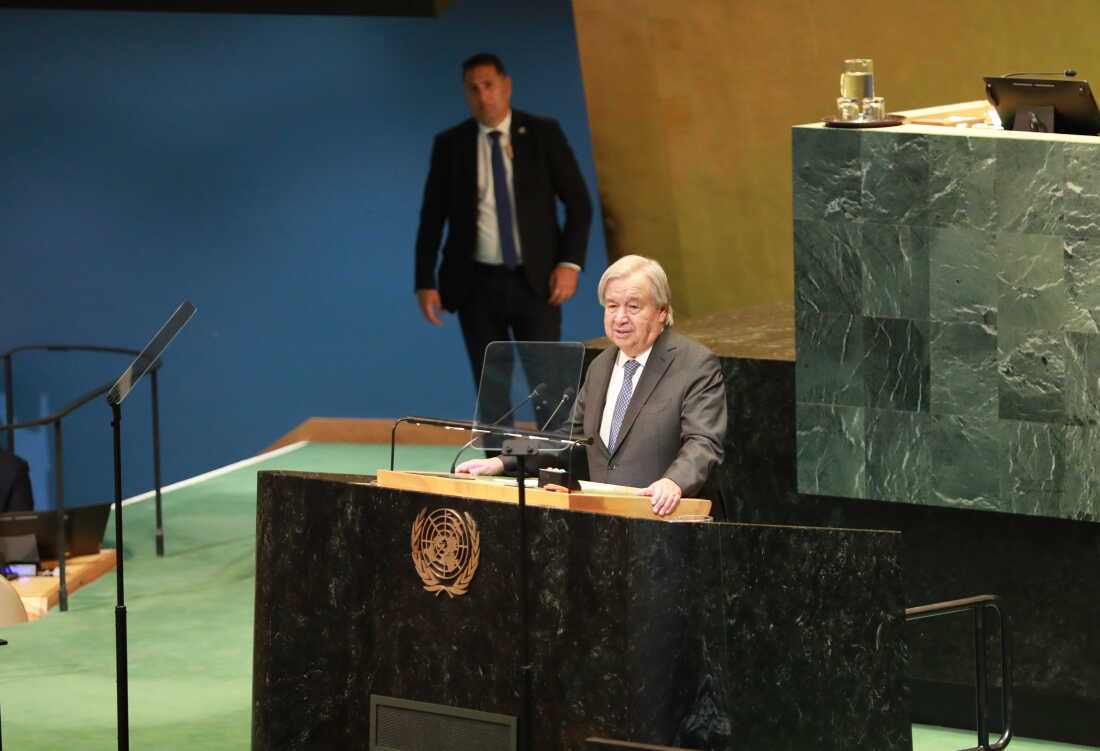
The 81st session of the U.N. General Assembly has commenced in New York, marked by a significant moment as U.N. Secretary-General António Guterres approaches the end of his tenure. He is attending his final high-level week in this role.
During his opening remarks, scheduled for Tuesday morning, Guterres plans to address global leaders in what he describes as an ‘era of deep uncertainty.’ Following the tradition, Brazilian President Luiz Inácio Lula da Silva will speak next, succeeded by U.S. President Donald Trump. The assembly features a packed schedule with various world leaders and top officials set to address attendees until September 28.
Guterres aims to use discussions with world leaders to advocate for de-escalation in the Middle East and maintain freedom of navigation through critical waterways like the Strait of Hormuz and the Bab el-Mandeb. Another focus is on pushing for a ceasefire in the ongoing Ukraine conflict, which has persisted well into its fifth year.
Iran
Iranian President Masoud Pezeshkian is scheduled to speak at the assembly on Wednesday, following President Trump’s address. The Iranian delegation is reportedly smaller this year due to visa restrictions imposed by the U.S. Some Iranian officials will face limitations on their movements and activities in New York, enforced by diplomatic security agents.
Guterres has been advocating for the opening of the Strait of Hormuz specifically for fertilizer shipments; however, these efforts have yet to gain substantial traction.
Ukraine and Russia
Ukrainian President Volodymyr Zelenskyy is also on the speakers list for Wednesday, rallying support from European allies as the country faces another war-torn winter. The role of the U.N. in the Ukraine conflict remains limited due to Russia’s veto power within the Security Council.
Russian President Vladimir Putin has not attended the General Assembly in over a decade. Instead, Russian Foreign Minister Sergey Lavrov is expected to speak on September 26 and meet with U.S. Secretary of State Marco Rubio on the sidelines.
Israel and the Palestinians
The Trump administration has denied visas for Palestinian Authority President Mahmoud Abbas and his delegation for a second consecutive year. In response, the U.N. General Assembly voted overwhelmingly to allow Abbas to deliver his speech via video, scheduled for Thursday morning.
Israeli Prime Minister Benjamin Netanyahu, currently engaged in an election campaign, will utilize his address time on Thursday to defend his policies on Iran and Gaza. There are planned protests against his speech, which New York City Mayor Zohran Mamdani does not intend to attend, despite earlier statements about Netanyahu’s arrest.
Split-Screen Diplomacy
While around 120 leaders and senior representatives gather at the U.N., notable absences include leaders from India, Germany, and South Africa, who are sending other senior representatives in their stead. China’s Xi Jinping will not attend in person, opting to speak via video.
Richard Gowan, director for global issues at the International Crisis Group, notes that the dual settings of Chinese and U.S. leaders meeting in Washington, alongside speeches from leaders of smaller nations in an almost empty General Assembly hall, may inadvertently highlight current power dynamics.
Venezuela
Delcy Rodríguez, Venezuela’s interim leader, will address the assembly Thursday afternoon, following the U.S. military’s intervention to detain former leader Nicolás Maduro. Rodríguez announced a substantial oil deal with the Trump administration, impacting Venezuela’s oil fields and future political landscape.
President Trump anticipates meeting Rodriguez on the sidelines, as Secretary of State Rubio calls the oil agreement a unique opportunity that could potentially aid both U.S. interests and a democratically elected government in Venezuela.
Race for U.N. Secretary-General
The U.N. Security Council continues straw polls to determine Guterres’ successor, with no consensus achieved so far. Potential candidates include Costa Rica’s Rebeca Grynspan and Guyana’s Carolyn Rodrigues Birkett, predominantly from Latin America.
The absence of a female leader historically at the helm has sparked encouragement for women’s candidacies, although Chile’s former President Michelle Bachelet has withdrawn from the race. The U.S. expresses its desire for the next secretary-general to reinforce fundamental U.N. values while they retain the power to veto candidates.
The selection process may be prolonged due to divisions within the Security Council, requiring an agreement on a candidate by the year’s end, coinciding with the end of Guterres’ term.